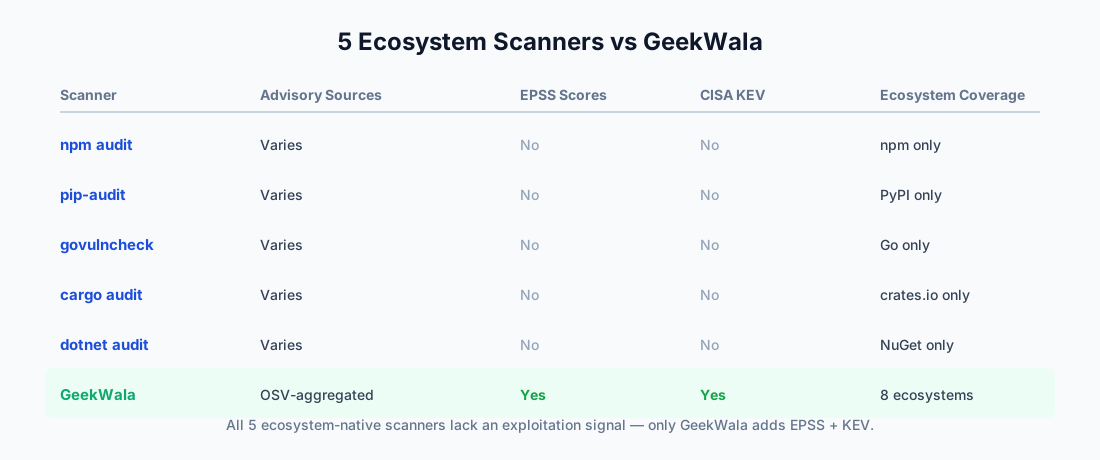
Ecosystem-native scanners are fast, free, and should be in every CI pipeline. But they all lack exploitation signals (EPSS, CISA KEV) and only cover their own ecosystem. Teams managing dependencies across multiple languages need a cross-ecosystem layer on top — that's what GeekWala adds.
Every major language ecosystem now ships (or adopts) a built-in vulnerability scanner. npm has npm audit. Python has pip-audit, maintained by the Python Packaging Authority. Go has govulncheck, backed by the official Go vulnerability database. Rust has cargo audit. .NET developers use dotnet audit.
They all answer the same question: "Do my dependencies have known vulnerabilities?"
None of them answer the follow-up: "Which of those vulnerabilities are actually being exploited right now?"
That's the gap. CVSS scores rank theoretical severity. EPSS ranks exploitation probability. CISA KEV flags confirmed active exploitation. The difference between a 200-item alert list and a 5-item action list often comes down to these signals.
We compared 5 ecosystem-native CLI scanners across the dimensions that matter for real-world vulnerability management — npm audit, pip-audit, govulncheck, dotnet audit, and cargo audit.
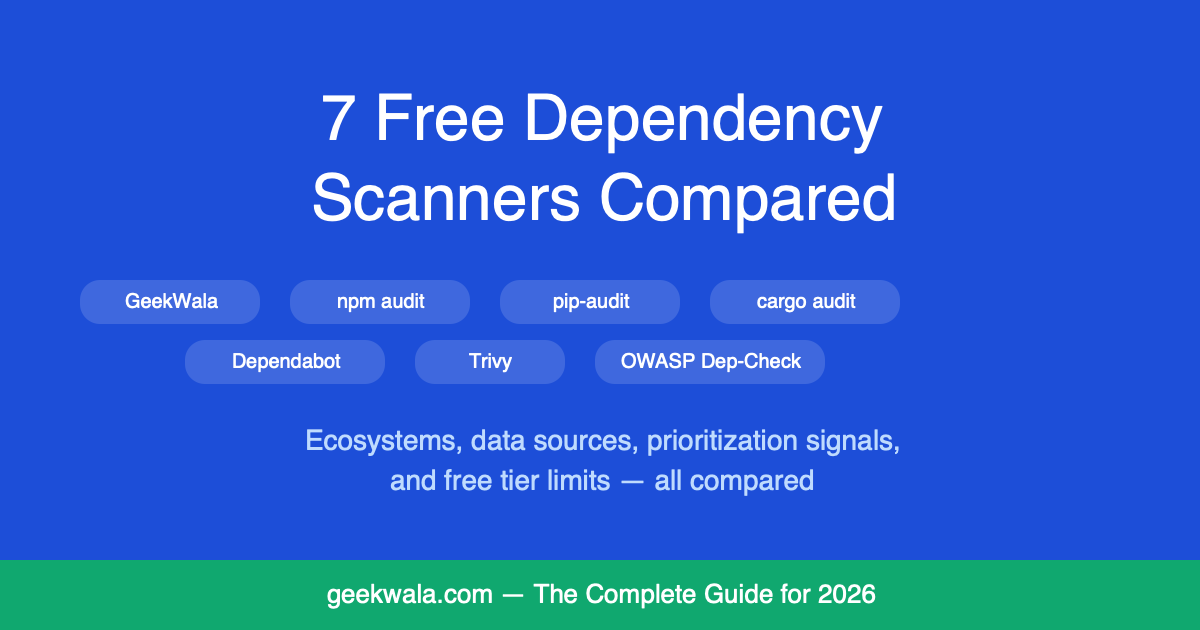
Scope note: This article focuses specifically on ecosystem-native CLI scanners (tools built into or closely tied to a single package manager). If you only care about these five, this is your deep-dive. If you're looking for the broader universe of free scanning tools — including GeekWala, Trivy, Dependabot, and OWASP Dependency-Check — see Free Dependency Scanning Tools in 2026.
In This Article
- How we compared
- The 5 scanners
- Comparison matrix
- Which scanner is right for you
- The multi-ecosystem problem
- FAQ
How We Compared
We evaluated each scanner across 10 dimensions:
- Advisory sources — Where does vulnerability data come from?
- EPSS integration — Does it show exploitation probability?
- CISA KEV integration — Does it flag known exploited vulnerabilities?
- Ecosystem coverage — How many package ecosystems does it scan?
- Prioritization — How does it rank findings beyond CVSS?
- CI/CD integration — Can it gate builds or run in pipelines?
- Automated fixes — Does it suggest or apply patches?
- Offline capability — Can it scan without network access?
- Pricing — Free, freemium, or paid?
- Unique strengths — What does this tool do better than the rest?
The Scanners
npm audit
npm's built-in scanner queries the npm Security Advisory Database (backed by GitHub Advisory Database and NVD). It runs automatically on npm install and can be invoked standalone with npm audit.
Strengths: Zero setup, runs automatically, npm audit fix can auto-patch within semver ranges.
Limitations: Severity labels only, with no ranking by CVSS or exploit probability, which creates alert fatigue at scale. No exploitation signals. npm ecosystem only. The --force flag for major version bumps can break applications.
Deep dive: npm audit vs GeekWala: Why CVSS Scores Alone Are Misleading
pip-audit
pip-audit (created by Trail of Bits with support from Google, maintained under the PyPA) checks Python dependencies against the PyPI advisory service (the default) or OSV. It supports requirements.txt, pyproject.toml (via pip-compile), and virtual environments.
Strengths: Integrates with both PyPI and OSV advisory data, supports --fix for automatic resolution, understands Python's complex dependency resolution.
Limitations: PyPI only. No EPSS or KEV. Doesn't natively parse Pipfile.lock or poetry.lock without conversion. Its limit is coverage, not freshness: PyPI advisories typically appear the same day as the NVD entry (median 0 days, n=738), but about 5.6% have no CVE ID, so CVE-keyed tools never see them.
Deep dive: Python Dependency Security: Scanning PyPI Packages for Vulnerabilities
govulncheck
Go's official vulnerability scanner, built by the Go security team. It uses the Go Vulnerability Database and performs call-graph analysis to determine if your code actually calls vulnerable functions.
Strengths: Call-graph analysis is unique — it reduces false positives by checking whether vulnerable code paths are reachable. Maintained by the Go team. Understands Go modules natively.
Limitations: Go ecosystem only. No EPSS or KEV. The Go Vulnerability Database is conservative and curated — it may miss CVEs that NVD tracks. Call-graph analysis requires source code access (can't scan from a lock file alone).
Deep dive: Go Vulnerability Scanning: What govulncheck Misses
dotnet audit
Microsoft's built-in vulnerability scanner for .NET projects. Checks NuGet packages against Microsoft's advisory database. Available as dotnet audit (newer) or dotnet list package --vulnerable (established).
Strengths: Native to .NET toolchain, supports PackageReference and packages.config. Microsoft's advisory database is well-maintained for the .NET ecosystem. Central Package Management support for monorepos.
Limitations: NuGet ecosystem only. No EPSS or KEV. Limited advisory coverage for non-Microsoft packages on NuGet. No prioritization beyond severity labels. No automated fix capability.
Deep dive: NuGet Vulnerability Scanning: What dotnet audit Misses
cargo audit
The Rust ecosystem's vulnerability scanner, powered by the RustSec Advisory Database. Checks Cargo.lock against curated advisories maintained by the Rust community.
Strengths: RustSec is exceptionally well-curated — low false positive rate. Tracks unmaintained crate warnings (unique among scanners). cargo-deny companion tool adds license compliance and duplicate detection. Fast execution.
Limitations: crates.io ecosystem only. No EPSS or KEV. RustSec's conservative curation means some NVD entries aren't covered. Limited coverage for C binding vulnerabilities in -sys crates. Smaller advisory database than NVD-backed tools.
Deep dive: Rust Vulnerability Scanning: What cargo audit Misses
Comparison Matrix
| Dimension | npm audit | pip-audit | govulncheck | dotnet audit | cargo audit |
|---|---|---|---|---|---|
| Advisory sources | npm + GHSA + NVD | PyPI (default) or OSV | Go Vuln DB | NuGet + MSRC | RustSec |
| EPSS scores | No | No | No | No | No |
| CISA KEV flags | No | No | No | No | No |
| Ecosystems | npm | PyPI | Go | NuGet | crates.io |
| Prioritization | Severity label | None (no severity column) | Reachability | Severity label | Advisory severity |
| Auto-fix | npm audit fix | --fix flag | No | No | No |
| CI/CD | npm audit --audit-level | Exit codes | Exit codes | MSBuild task | cargo audit in CI |
| Offline mode | No | Yes (with local DB) | Yes (with local DB) | No | Yes (with local DB) |
| Call-graph analysis | No | No | Yes | No | No |
| Pricing | Free | Free | Free | Free | Free |
| Unique strength | Auto-fix PRs | PyPA-maintained, OSV option | Call-graph filtering | .NET native | Unmaintained crate warnings |
None of these five expose EPSS or CISA KEV natively. For a cross-ecosystem layer that adds exploitation-probability and confirmed-active-exploitation signals on top of these scanners — plus OWASP Dependency-Check, Trivy, and Dependabot — see Free Dependency Scanning Tools in 2026.
See pricing page for current pricing.
Which Scanner Is Right for You
Single-ecosystem teams
If your entire stack is one language, use the ecosystem-native scanner as your baseline:
- Node.js only → npm audit (+ GeekWala for EPSS/KEV prioritization)
- Python only → pip-audit (+ GeekWala for exploitation signals)
- Go only → govulncheck (call-graph analysis is genuinely useful)
- Java only → OWASP Dependency-Check or Snyk (if budget allows)
- .NET only → dotnet audit (+ GeekWala for prioritization)
- Rust only → cargo audit + cargo-deny (RustSec is excellent)
- PHP/Composer →
composer auditcovers the basics, but Packagist has no ecosystem-native exploitation signals. See PHP and Packagist Dependency Security for a full breakdown.
Multi-ecosystem teams
This is where the native tools fall apart. A team running Node.js, Python, and Go has three separate scanners with three different advisory databases, three different severity scales, and no way to compare findings across them.
Options:
- GeekWala — Unified dashboard, EPSS/KEV across all ecosystems, see pricing
- Snyk — Full AppSec platform, per-developer pricing, broader than SCA
- OWASP Dependency-Check — Free, multi-ecosystem, but NVD-only with high false positives
For teams that need dependency scanning with exploitation signals but not a full AppSec platform, GeekWala fills the gap between "run each scanner separately" and "buy an enterprise platform."
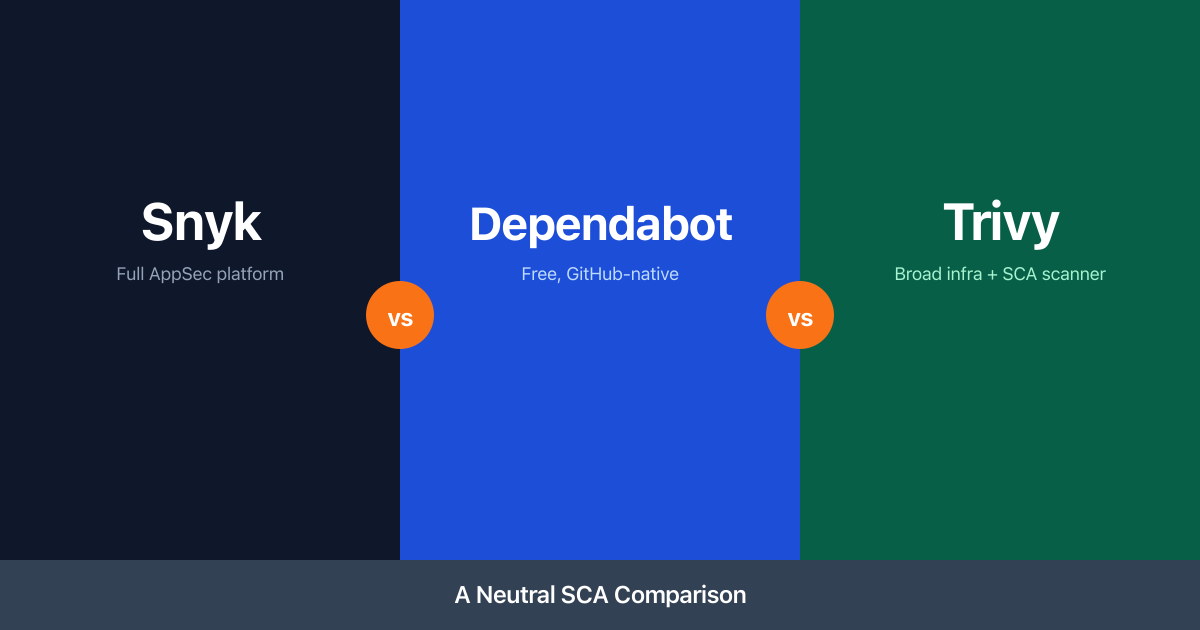
For detailed Snyk and Dependabot comparisons, see GeekWala vs Snyk and GeekWala vs Dependabot. If you're specifically weighing Google's official OSV database frontend or an enterprise SCA platform, see OSV-Scanner vs GeekWala for the technical deep-dive or the OSV-Scanner feature comparison for pricing and feature tables, and GeekWala vs Mend or the Mend feature comparison if you're evaluating the enterprise end of the market. If behavioral/malicious-package detection is the gap you're closing rather than known-CVE prioritization, see GeekWala vs Socket or the Socket feature comparison — the two approaches solve different problems and are often run together.
Decision criteria summary
| If you need... | Use... |
|---|---|
| Zero-config npm scanning | npm audit |
| Python with auto-fix | pip-audit |
| Go with reachability analysis | govulncheck |
| Enterprise Java reporting | OWASP Dependency-Check |
| .NET native integration | dotnet audit |
| Rust with maintenance warnings | cargo audit + cargo-deny |
| Exploitation-aware prioritization | GeekWala |
| Full AppSec platform | Snyk |
| Automated GitHub PRs | Dependabot |
The Multi-Ecosystem Problem
Modern applications rarely use a single language. A typical SaaS product might have:
- Frontend: React (npm) — 800 packages in
package-lock.json - API: Python FastAPI (PyPI) — 120 packages in
requirements.txt - Infrastructure: Go microservices — 60 modules in
go.sum - Data pipeline: Java Spark jobs — 200 dependencies in
pom.xml
That's 1,180 dependencies across 4 ecosystems, checked by 4 separate scanners, reported in 4 different severity formats. When your CISO asks "what's our highest-risk dependency across the entire platform?" — you're opening 4 tabs and doing mental arithmetic.
The 3-signal triage method cuts through this: for any CVE in any ecosystem, check CVSS (theoretical severity), EPSS (exploitation probability in the next 30 days), and CISA KEV (confirmed active exploitation). These signals are ecosystem-agnostic — a CVSS 7.5 with EPSS 0.8 is equally urgent whether it's in npm, PyPI, or Maven.
This is what cross-ecosystem scanning enables. Not replacing the native tools — they're fast, free, and should stay in your pipeline — but adding a prioritization layer that works across all of them.
Frequently Asked Questions
Should I stop using my ecosystem's native scanner if I use GeekWala?
No. Keep npm audit, pip-audit, govulncheck, etc. in your CI pipeline. They're fast, free, and catch issues at development time. GeekWala adds the prioritization layer — use it to decide which findings from your native scanner deserve immediate attention vs. next sprint vs. accepted risk.
Why don't the native scanners include EPSS?
EPSS is maintained by FIRST.org and updated daily — it scores every published CVE (355,000+ as of mid-2026, and growing as new CVE IDs are assigned). Integrating it requires fetching, caching, and correlating EPSS data with each scanner's advisory database. The native tools are focused on their ecosystem's advisory data and keep dependencies minimal. Adding EPSS would increase complexity and require network calls that conflict with some tools' offline-first design.
What about OWASP Dependency-Check or GeekWala?
Both are covered in our companion article rather than here — this piece focuses specifically on tools built into a single ecosystem's own package manager. OWASP Dependency-Check is Java-focused but technically multi-ecosystem (NVD-based CPE matching, high false-positive rate outside Maven/Gradle). GeekWala is a cross-ecosystem layer that adds EPSS and CISA KEV signals on top of scanners like these five. See Free Dependency Scanning Tools in 2026 for the full write-up on both.
What about Trivy, Grype, or other container-focused scanners?
Trivy (Aqua Security) and Grype (Anchore) are excellent tools that scan container images, filesystems, and git repositories. They pull from multiple advisory databases and support many ecosystems. They're closer to Snyk in scope — broader than dependency scanning alone. Grype now includes native EPSS and CISA KEV enrichment, which is a genuine strength — see our GeekWala vs Grype comparison for a fair head-to-head, or the Grype feature-by-feature comparison for pricing and feature tables side by side. If you're already using Trivy or Grype for container scanning, you could use them for SCA too. GeekWala adds a web dashboard, scan history, and team visibility on top of exploitation signals.
What about Vulert, Aikido Security, or Semgrep Supply Chain?
These three solve adjacent problems, each in a different direction. Vulert is a straightforward dependency monitor across 11 languages with hourly scans — closest in scope to the five tools above, but priced per application ($20-125+/mo) rather than flat-rate. Aikido Security bundles SCA with SAST, secrets detection, IaC, and cloud posture scanning into one AppSec platform — comprehensive if you need the whole surface, priced per 10-user block starting at $300/mo. Semgrep Supply Chain is the SCA module of Semgrep's platform and uses reachability analysis — checking whether a vulnerable dependency's code path is actually called — to cut false positives, at $30/contributor/month. None of the five ecosystem-native scanners above do reachability analysis or bundle a full AppSec suite; that's the gap these three fill.
How often should I scan?
At minimum: every CI build (using the native scanner) and weekly (using GeekWala or your cross-ecosystem tool of choice). EPSS scores change daily as new exploit data emerges — a finding that was EPSS 0.1 last week could spike to 0.8 this week. Scheduled GeekWala scans (Pro) re-rank your findings by the current EPSS on every run, so a score that jumped between deploys moves up the list.
Every ecosystem has a scanner. None of them rank by exploitation risk.
Scan your dependencies across 8 ecosystems with EPSS + CISA KEV → — upload a lock file, see which vulnerabilities are being actively exploited, and prioritize what matters. No account needed for up to 10 packages.
For a deeper, criteria-by-criteria breakdown of the three most commonly evaluated SCA tools, see Snyk vs Dependabot vs Trivy: A Neutral SCA Comparison.