Mend is enterprise SCA — broad platform coverage (SCA, containers, SAST, license compliance) with per-developer, contact-sales pricing. GeekWala is single-purpose dependency scanning across 8 ecosystems with EPSS and CISA KEV on every finding, at a flat $12/mo Pro price. Large orgs needing license compliance and container scanning should pick Mend; small-to-mid teams wanting exploitation-aware triage without a sales cycle should pick GeekWala.
Mend — rebranded from WhiteSource in 2022 — is one of the longer-established names in software composition analysis (SCA). It's built for enterprise application security teams: SCA, container scanning, SAST, and license compliance under one platform, sold with per-developer, contact-sales pricing. GeekWala is a narrower, flat-rate dependency scanner: eight ecosystems, EPSS and CISA KEV enrichment on every finding, and a price you can see without booking a call.
Neither of those is automatically the right answer. This comparison is meant to help you figure out which one is, honestly — including when Mend is the better fit.
Already comparing pricing and features to make a buying decision? See our full GeekWala vs Mend comparison for the complete feature matrix and pricing breakdown. This article instead digs into pricing transparency, the EPSS/KEV distinction, and a migration path in more depth.
In This Article
- Feature-by-feature comparison
- Pricing transparency
- EPSS and KEV: how the two actually differ
- When Mend is the right choice
- Migration path
- FAQ
Feature-by-feature comparison
| Dimension | Mend (WhiteSource) | GeekWala |
|---|---|---|
| Core product | Enterprise SCA + container + SAST + license compliance platform | Dependency vulnerability scanning |
| Ecosystem coverage | Broad, enterprise-language coverage | 8 ecosystems (npm, PyPI, Maven, Packagist, Go, crates.io, RubyGems, NuGet) |
| EPSS exploitation score | Yes | Yes, on every finding |
| CISA KEV flagging | Not surfaced as a labeled, first-party field | Yes, on every finding |
| License compliance scanning | Yes | Limited: separate License Checker tool, not part of scans |
| Container image scanning | Yes | No |
| Pricing model | Per developer, contact sales | Flat-rate, no seat minimum |
| Published pricing | Not public | Public pricing page |
| Minimum team cost | Contact sales | $0 (Free tier) |
| Self-serve signup | Typically sales-led | Yes — scan anonymously or sign up free |
| Scheduled scans | Yes | Yes (Pro) |
| Best fit | Large orgs needing SCA + license + container in one platform | Small-to-mid teams wanting fast, exploitation-aware dependency triage |
Feature and pricing claims for Mend reflect its public product marketing and GeekWala's own pricing page competitor comparison data as of July 2026. Mend does not publish self-serve pricing, so exact per-seat costs should be verified directly with Mend's sales team before making a purchasing decision — pricing pages for enterprise platforms change without much public notice.
Pricing transparency
This is the sharpest, most durable difference between the two tools, and it's worth leading with rather than burying in a feature table: Mend requires a sales conversation to get a real number, while GeekWala publishes a flat monthly price anyone can see before signing up.
Mend prices per developer, and Mend's own pricing page (verified 2026-09-15) shows only an upper-bound estimate — "up to $1,000 per developer/year" for its AppSec product — with every section funneling to a "Get a demo" call-to-action rather than a fixed quote. That's standard for enterprise security platforms selling into procurement-heavy organizations, and it isn't a knock against Mend: contact-sales pricing usually reflects negotiated volume discounts, custom SLAs, and bundled modules that a flat public price can't represent well. But it does mean you can't get an exact number for your team without a sales conversation, and that upper-bound figure alone puts Mend AppSec in five- and six-figure annual territory once you're past a handful of seats.
GeekWala's pricing page lists a Free tier and a flat $12/mo (or $99/yr) Pro plan — no per-seat multiplier, no minimum team size, no sales call required to see the number. That's a deliberate tradeoff: GeekWala doesn't try to match Mend's platform breadth, and in exchange it doesn't need Mend's pricing model either. If your team is under, say, 20 engineers and doesn't need license compliance or container scanning, the price gap between "contact sales" and "$12/mo flat" is usually the whole decision by itself.
EPSS and KEV: how the two actually differ
By mid-2026, EPSS scoring — defined by FIRST.org as a model estimating 30-day exploitation probability — is close to table stakes: Mend, like Snyk and GitHub Dependabot, surfaces EPSS on its findings via its Reachability feature. So "GeekWala has EPSS and Mend doesn't" isn't an honest claim; the real gap is CISA KEV, covered next.
Where the two diverge is CISA KEV. GeekWala flags CISA KEV status as its own labeled field on every finding — the least ambiguous "this is being exploited right now" signal available, sourced directly from CISA's public Known Exploited Vulnerabilities catalog. Mend doesn't surface a labeled, first-party KEV indicator in the same way; if KEV data factors into its scoring at all, it isn't broken out as its own labeled field. For a team trying to answer "is anything on our patch list actually a confirmed, in-the-wild exploit," that's a real, checkable difference — not a marketing distinction.
GeekWala shows both signals on every finding, ranked KEV first, then EPSS above 10%, then severity, so severity, exploitation probability, and confirmed exploitation triage in one list instead of three separate fields to cross-reference by hand:
▲ EPSS Score — Exploit Probability (high → low)
~85% of CVEs are noise (bottom-left). Focus energy on the top row — especially top-right where severity meets active exploitation.
When Mend is the right choice
Being direct about this matters more than winning the comparison — a narrower, cheaper tool isn't automatically the right answer for every team. Mend is the better choice for these four situations, each a genuine, checkable Mend strength GeekWala doesn't attempt to replicate:
- You need license compliance scanning. Legal and procurement teams flagging GPL, AGPL, or other copyleft licenses in your dependency tree is a Mend strength; GeekWala only offers a separate License Checker tool that classifies license risk, not license policy enforcement inside scans.
- You need container image scanning in the same platform. If your threat model spans containers and application dependencies and you want one vendor for both, Mend covers ground GeekWala doesn't.
- You're already an enterprise buyer with procurement relationships. If your org already runs Mend for other AppSec needs, or your security team has existing SLAs and support relationships with Mend, consolidating there has real operational value that a cheaper point tool can't offset.
- You need SAST alongside SCA. Mend's broader platform reach means fewer vendors to manage if your security program spans static analysis and composition analysis.
If any of those describe your team, GeekWala isn't a substitute — it's a narrower tool solving a narrower problem, and that's fine. It's also worth sanity-checking that assumption before signing anything: if what you actually need is dependency scanning with better exploitation signals — not license compliance or container coverage — narrower and cheaper tends to win. Our scanner comparison hub lines GeekWala up against Snyk, Dependabot, npm audit, and Trivy on the same criteria used here, in case Mend isn't the only enterprise option you're weighing.
Migration path
If you're moving from Mend to GeekWala — typically because you only ever used its SCA module and were paying full platform pricing for that single feature — the five-step practical path below is additive and reversible, not a one-way rip-and-replace commitment:
- Keep Mend running for any license compliance or container scanning you still need, if those matter to your org.
- Scan your existing lockfiles in GeekWala to confirm coverage parity for your ecosystems before switching over dependency-scanning duties.
- Compare findings for a sprint or two. Since both tools use overlapping vulnerability data sources, you should see broadly similar CVE lists — the EPSS/KEV triage view is what you're actually evaluating.
- Move scheduled dependency scans to GeekWala's Pro plan once you're confident in coverage, and drop the SCA-only seats from your Mend contract at renewal.
- Keep Mend for anything GeekWala doesn't do — license and container scanning stay on Mend if you need them; GeekWala isn't trying to replace that half of the platform.
For a broader look at where GeekWala sits against other SCA and dependency-scanning tools, see our dependency scanner comparison.
FAQ
Is Mend the same company as WhiteSource?
Yes. WhiteSource rebranded to Mend in 2022. The product lineage and core SCA capability carried over under the new name.
Does Mend support EPSS scoring?
Yes — by mid-2026, EPSS is standard across most established SCA vendors, including Mend, Snyk, and GitHub Dependabot. It is no longer a differentiator on its own.
Does Mend show CISA KEV status?
Not as a labeled, first-party field in the way GeekWala does. If CISA KEV data factors into Mend's internal risk scoring, it isn't broken out as a dedicated, labeled indicator the way a KEV flag is.
How much does Mend cost compared to GeekWala?
Mend prices per developer and doesn't publish self-serve rates — you'll need to talk to their sales team for an exact number. GeekWala publishes a flat $12/mo (or $99/yr) Pro plan with a Free tier and no seat minimum. As a rule of thumb, once a per-developer enterprise SCA quote clears roughly $125-150/mo for a small team, a flat-rate tool covering the same core dependency-scanning need is worth a second look — even if it means giving up the platform breadth Mend offers.
Does GeekWala do license compliance scanning like Mend?
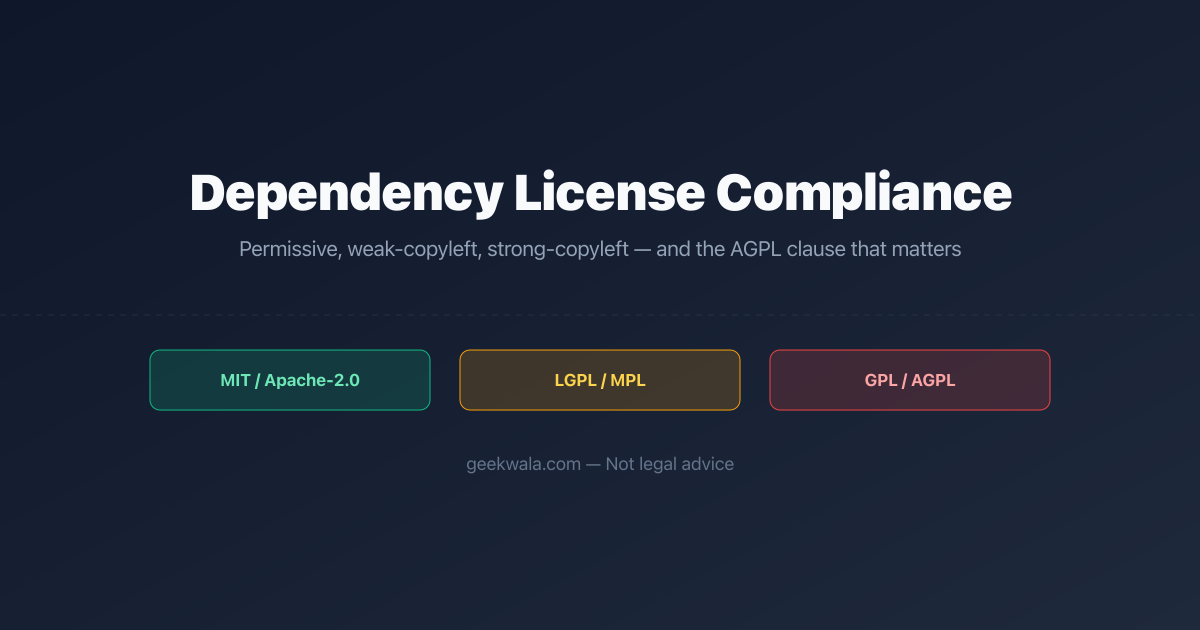
Not inside scans, and this article isn't pretending otherwise. GeekWala has a separate License Checker tool that classifies the license risk of a manifest (permissive, weak copyleft, strong copyleft, unknown), but if GPL/AGPL/copyleft license flagging with policy enforcement is a hard requirement for your legal or procurement team, that's a genuine Mend advantage GeekWala doesn't attempt to replicate — see "When Mend is the right choice" above.
Can I use both tools together?
Yes. Some teams keep Mend for license compliance and container scanning while using GeekWala for day-to-day dependency vulnerability triage — the two aren't mutually exclusive, and GeekWala doesn't attempt to replace Mend's full platform.
Scan your dependencies → — paste a lockfile from any of 8 ecosystems and see EPSS scores and CISA KEV flags on every finding. No install, no account required.