Socket excels at detecting malicious packages and typosquatting attacks before they enter your codebase. GeekWala excels at prioritizing known CVEs with EPSS and KEV enrichment across 8 ecosystems. The strongest dependency security setup uses behavioral analysis (Socket) to catch unknown threats alongside CVE prioritization (GeekWala) to manage known vulnerabilities. If you can only pick one, choose based on your primary threat: supply chain injection or vulnerability backlog.
Most dependency security tools answer the same question: "does this package have a known CVE?" Socket asks a fundamentally different question: "is this package doing something suspicious?" That distinction matters more than most developers realize, because supply chain attacks increasingly bypass the CVE system entirely.
GeekWala and Socket are not competitors in the traditional sense. They solve different halves of the same problem. Socket uses behavioral analysis to detect malicious packages — code that exfiltrates environment variables, runs install scripts that phone home, or mimics popular package names with subtle typos. GeekWala uses CVE database matching enriched with EPSS exploitation probability and CISA KEV active exploitation data to help you prioritize the vulnerabilities that actually matter.
The confusion happens because both tools live in the "dependency security" category. But choosing between them is like choosing between a smoke detector and a deadbolt — they protect against different threats, and the best security posture uses both.
Already comparing pricing and features to make a buying decision? See our full GeekWala vs Socket comparison for the complete feature matrix and pricing. This article instead digs into how each tool's detection approach actually differs.
The Two Approaches to Dependency Security
Dependency vulnerability scanning traditionally means matching your installed packages against a database of known CVEs. A vulnerability is discovered, an advisory is published, scanners pick it up, and you get an alert. This is reactive by definition — the vulnerability must be publicly known before any scanner can flag it.
Behavioral analysis takes a different approach. Instead of waiting for advisories, it inspects what packages actually do: Does this package access the filesystem outside its expected scope? Does it make network requests during installation? Does it read environment variables and send them somewhere? Does its name differ from a popular package by one character?
Neither approach is inherently better. CVE-based scanning catches the vast majority of real-world dependency risks — most security incidents still come from known, unpatched vulnerabilities sitting in production for months. But behavioral analysis catches the attacks that CVE databases never will: a maintainer's compromised npm account pushing a malicious update, a typosquatted package harvesting credentials, or a new dependency that hasn't been reported yet.
The 2024-2025 wave of supply chain attacks on npm and PyPI demonstrated that both categories of threat are real and growing. The event-stream incident, ua-parser-js compromise, and dozens of smaller npm attacks all involved malicious code that no CVE scanner could have caught — because no CVE existed. Meanwhile, the Log4Shell and Spring4Shell vulnerabilities showed that known CVEs with high exploitation probability still account for the majority of actual breaches.
What Socket Does Well
Socket has earned significant credibility in the supply chain security space. Here is a fair accounting of its genuine strengths:
Malicious package detection through behavioral analysis. Socket's core capability is analyzing what packages do, not just what vulnerabilities they have. It inspects install scripts, network calls, filesystem access patterns, and dynamic code execution to flag packages that behave suspiciously. This catches threats that CVE databases cannot — compromised maintainer accounts, malicious updates to legitimate packages, and entirely new attack packages.
Typosquatting alerts. Socket detects packages with names suspiciously similar to popular libraries. If someone publishes lodasch or reqeusts (note the typos), Socket flags it. This is a real and growing attack vector — attackers register hundreds of near-miss package names hoping developers will mistype an install command.
Real-time npm and PyPI threat intelligence. Socket has built a reputation for catching malicious packages quickly. Their research team regularly publishes findings about new supply chain attacks, and their database of suspicious packages is continuously updated. Several high-profile malicious package discoveries were first reported by Socket's analysis.
PR-level GitHub integration. Socket's GitHub app reviews pull requests that introduce new dependencies. Before a dependency enters your codebase, Socket analyzes its behavior and flags risks directly in the PR. This is a strong "shift left" pattern — catching malicious dependencies at the PR review stage rather than after they are installed.
Strong research and incident response. Socket's security research team actively publishes analysis of supply chain attacks. Their blog and advisories have become a respected source of threat intelligence for the npm and PyPI ecosystems. This is not just a product feature — it is a genuine contribution to the security community.
What Socket Doesn't Do
Socket's behavioral analysis focus means it intentionally omits several capabilities that matter for vulnerability management:
No CVE prioritization with exploitation context. Socket detects malicious packages, but it does not provide EPSS scores that tell you the probability a known CVE will be exploited in the next 30 days. When you have 200 CVEs across your dependency tree, knowing which 5 have a greater than 10% exploitation probability changes your entire remediation strategy.
No CISA KEV integration. The CISA Known Exploited Vulnerabilities catalog tracks CVEs that are confirmed to be actively exploited in the wild. Socket does not cross-reference findings against KEV, which means you lack a critical signal for distinguishing theoretical risk from confirmed exploitation.
Ecosystem coverage is concentrated on npm and PyPI. Socket's behavioral analysis is strongest for JavaScript and Python packages. If your stack includes Go modules, Rust crates, PHP/Composer, Maven/Java, Ruby, or .NET — ecosystems where supply chain attacks are less frequent but known CVEs still accumulate — Socket's coverage is thinner.
No multi-ecosystem vulnerability dashboard. Socket's interface is oriented around PR reviews and package-level analysis rather than a centralized dashboard showing vulnerability posture across all your projects and ecosystems simultaneously.
No historical vulnerability tracking. Socket focuses on point-in-time analysis — primarily at the PR or package level. There is no built-in mechanism for tracking how your vulnerability exposure changes over weeks or months, or for identifying trends in your dependency risk.
No scheduled scanning for ongoing CVE monitoring. Socket's primary trigger is new dependency additions via PRs. It does not continuously re-scan your existing dependencies for newly published CVEs the way a scheduled vulnerability scanner does.
What GeekWala Does Well
GeekWala's strength is turning a wall of CVEs into an actionable prioritized list:
EPSS exploitation probability on every CVE. Every vulnerability GeekWala surfaces includes its EPSS score — the statistical probability it will be exploited in the wild within the next 30 days. This transforms triage from "fix all HIGHs" to "fix the 3 CVEs most likely to be actually exploited." For teams drowning in vulnerability backlogs, this is the difference between meaningful remediation and checkbox compliance.
CISA KEV cross-reference for confirmed exploitation. When a CVE in your scan results appears on CISA's Known Exploited Vulnerabilities catalog, GeekWala flags it on the finding. KEV entries are not theoretical risks — they are confirmed active exploits, often with binding operational directives for federal agencies. This signal cuts through CVSS score noise.
8-ecosystem coverage from one dashboard. npm, PyPI, Maven, Go modules, crates.io, Packagist, RubyGems, and NuGet — all scanned from the same interface with consistent EPSS and KEV enrichment. No switching tools, no reconciling different severity scales, no ecosystem blind spots.
Historical tracking and trending. Every scan is stored. You can track how your vulnerability count changes over time, when specific CVEs entered your dependency tree, and whether your remediation efforts are actually reducing risk. Free accounts get 30 days of history; Pro gets 1 year.
Scheduled scans with alerting. Pro accounts get daily and weekly scheduled scans. When a new CVE matches your existing dependencies, the scan email tells you without waiting for the next PR or manual scan, and each re-scan ranks findings by today's EPSS.
Anonymous instant scanning. Paste a lock file at geekwala.com/scanner and get enriched results immediately. No installation, no account creation, no GitHub app authorization. For evaluating a new library or running a one-off audit, the friction is near zero.
REST API for CI/CD integration. GeekWala's API lets you embed vulnerability checks into build pipelines with the same EPSS and KEV enrichment available in the web dashboard.
What GeekWala Doesn't Do
GeekWala is a CVE-based scanner. That means it has inherent limitations:
No behavioral analysis. GeekWala cannot detect malicious packages that have not yet been assigned a CVE or advisory. If a compromised maintainer pushes a malicious update to a legitimate package today, GeekWala will not flag it until an advisory is published — which could take hours, days, or longer.
No typosquatting detection. GeekWala does not analyze package names for similarity to popular libraries. If you install colurs instead of colors, GeekWala will scan it for known CVEs but will not alert you that the package name is suspiciously similar to a popular library.
No install script analysis. GeekWala does not inspect what packages do at install time. Post-install scripts that exfiltrate environment variables, download additional payloads, or modify system files are outside GeekWala's detection scope.
Reactive by nature. A CVE must exist in a public advisory database before GeekWala can flag it. This is true of all CVE-based scanners — the vulnerability has to be known before it can be detected. Zero-day supply chain attacks are invisible to this approach.
Feature Comparison
| Feature | GeekWala | Socket |
|---|---|---|
| Detection method | CVE database matching | Behavioral analysis |
| Primary strength | Vulnerability prioritization | Malicious package detection |
| EPSS scoring | Yes — on every finding | No |
| CISA KEV integration | Yes — flagged on every finding, ranked first | No |
| Typosquatting detection | No | Yes |
| Install script analysis | No | Yes |
| Malicious package detection | No (requires published CVE) | Yes (behavioral) |
| Ecosystems | 8 (npm, PyPI, Maven, Go, Rust, PHP, Ruby, .NET) | Primarily npm, PyPI |
| Web dashboard | Yes — multi-project, multi-ecosystem | GitHub app integration |
| Historical tracking | Yes (30 days free, 1 year Pro) | PR-level only |
| Scheduled scans | Daily/weekly (Pro) | On PR/push events |
| Anonymous scanning | Yes (no account needed) | No |
| API | REST API + GitHub Action | GitHub app |
| CI/CD integration | GitHub Action (can fail the build on KEV or an EPSS threshold) and API | GitHub app, PR comments |
| Free tier | Yes (5 projects, 50 scans/mo) | Yes (open-source repos) |
| Pricing | Free tier + Pro | Free for open source, paid for private repos |
See pricing page for current GeekWala pricing.
When to Use Both
The strongest dependency security posture layers both approaches:
Socket at the gate. Socket's GitHub app reviews every PR that introduces a new dependency. Before malicious code enters your codebase, Socket's behavioral analysis flags suspicious install scripts, network access patterns, and typosquatted names. This is your first line of defense against supply chain injection attacks.
GeekWala for ongoing monitoring. Once dependencies are in your codebase, GeekWala re-scans them on a schedule (Pro) for known CVEs with exploitation context. Scheduled scans catch newly published vulnerabilities between deploys. EPSS scores tell you which of your 50 open CVEs to fix first. KEV flags tell you which ones are already being exploited.
This is not tool duplication. Socket answers "is this new dependency safe to install?" GeekWala answers "which of my existing dependencies need attention right now?" These are sequential questions in a healthy dependency management workflow.
When to Choose One
If budget or tooling complexity constraints force a choice, here is how to decide:
- Primary concern is supply chain injection attacks (malicious packages, compromised maintainers, typosquatting) — choose Socket. Its behavioral analysis catches threats that no CVE scanner can detect.
- Primary concern is vulnerability backlog prioritization (too many CVEs, unclear which to fix first) — choose GeekWala. EPSS and KEV enrichment transform triage from guesswork into data-driven prioritization.
- Non-npm/PyPI ecosystems are significant (Go, Rust, PHP, Java, Ruby, .NET) — choose GeekWala. Socket's behavioral analysis coverage outside npm and PyPI is limited. GeekWala scans all 8 ecosystems with consistent enrichment.
- Budget constraints with broad ecosystem needs — GeekWala's free tier covers 5 projects across all 8 ecosystems with 50 scans per month. Socket's free tier is limited to open-source repositories.
- Enterprise with full budget — use both. Socket for ingress protection, GeekWala for ongoing vulnerability management. The coverage gap between them is where real risk lives.
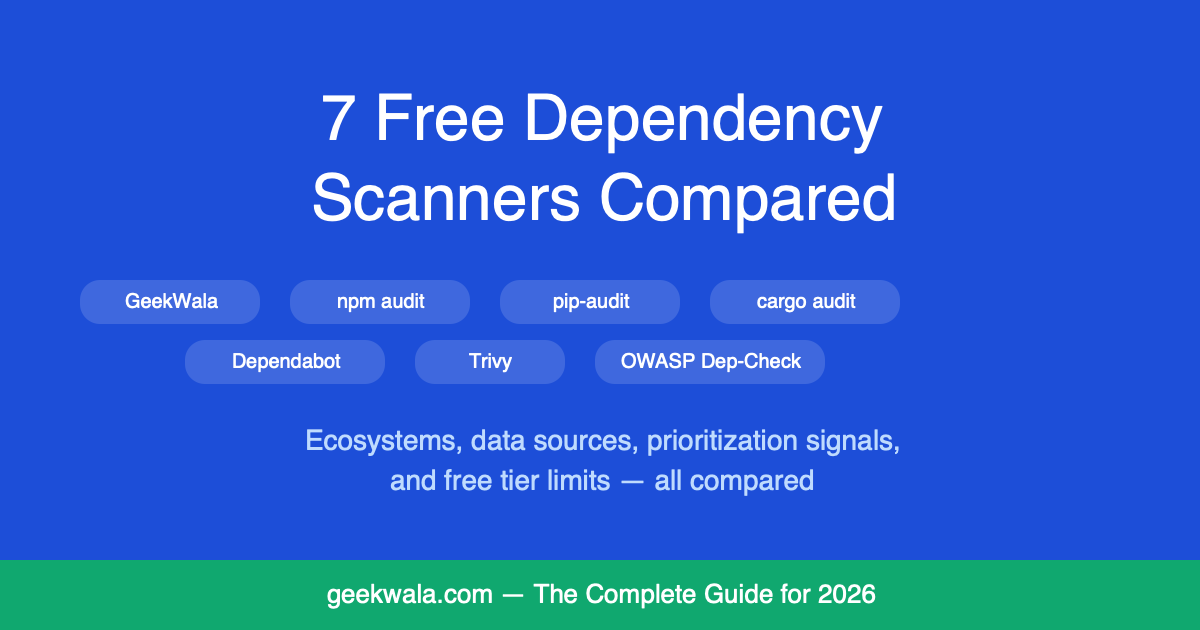
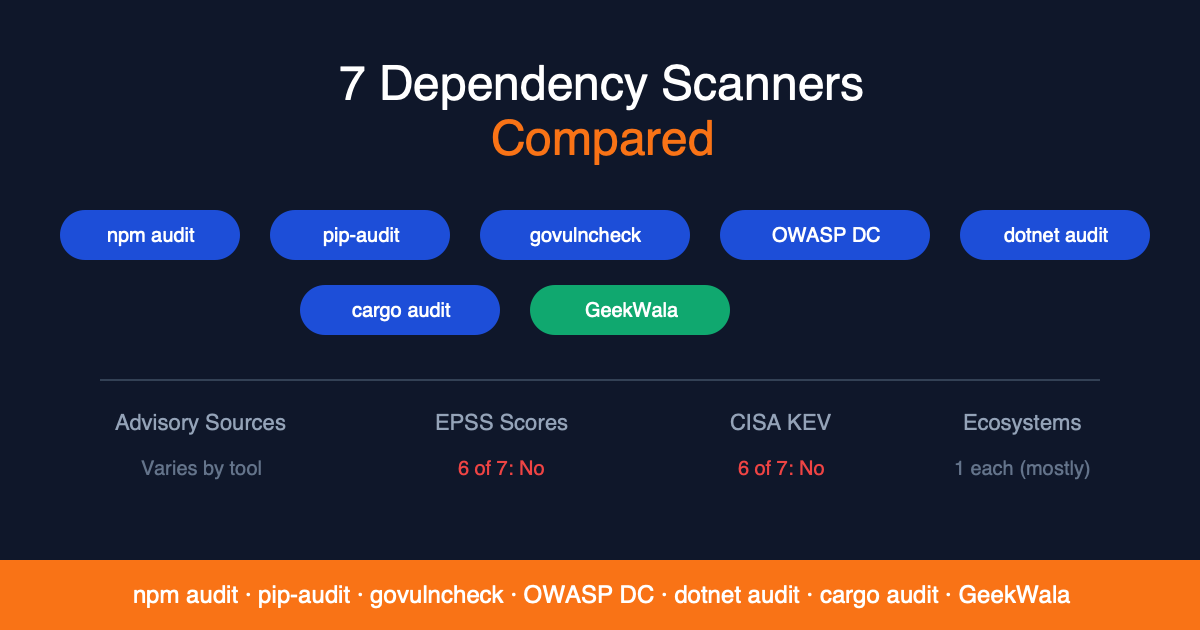
For a broader view of how these tools fit into the dependency scanning landscape, see 7 Dependency Scanners Compared.
Frequently Asked Questions
Can GeekWala detect malicious packages?
No. GeekWala is a CVE-based scanner — it matches your dependencies against public vulnerability data (OSV, which includes GHSA) and enriches findings with EPSS and KEV data. If a malicious package has not been assigned a CVE or advisory, GeekWala will not flag it. For malicious package detection, you need behavioral analysis (Socket) or manual code review. The two approaches are complementary, not interchangeable.
Does Socket provide EPSS scores?
No. Socket focuses on behavioral analysis and threat detection rather than CVE enrichment. If you need EPSS exploitation probability scoring to prioritize your vulnerability backlog, that is GeekWala's core strength. Socket may flag a package as "high risk" based on its behavior, but it does not provide the statistical exploitation probability that EPSS offers for known CVEs.
Which tool should I use for Go or Rust dependencies?
GeekWala. Socket's behavioral analysis is strongest for npm and PyPI, where supply chain attacks are most frequent. For Go modules, Rust crates, and other ecosystems beyond JavaScript and Python, GeekWala's 8-ecosystem CVE scanning with EPSS and KEV enrichment provides broader coverage. If you use Go or Rust alongside npm, consider both tools — Socket for your JavaScript dependencies and GeekWala across the full stack.
Socket catches what CVE databases can't. GeekWala prioritizes what CVE databases find.
Scan your dependencies across 8 ecosystems → — upload any lock file, see EPSS and KEV scores for every finding, and track vulnerability trends over time. No installation needed. For more comparisons, see GeekWala vs Grype, 7 Dependency Scanners Compared, and free dependency scanning tools.