Snyk's Free plan is $0 but caps at 200 open-source tests across 5 projects. Team starts at $25 per contributing developer per month with no published seat minimum; Ignite starts at $1,260/developer/year; Enterprise is custom pricing. GeekWala's Pro plan is a flat $12/month regardless of team size.
Snyk's pricing page shows four tiers, but the number that actually determines your bill isn't listed on the page in dollars — it's "contributing developers," Snyk's term for anyone who's committed to a private repo Snyk monitors in the last 90 days. That number grows with your team whether or not everyone touches security findings, and it's the single biggest driver of what Snyk actually costs versus what the pricing page implies at a glance.
Want the full side-by-side breakdown? See our Snyk pricing comparison for the tier-by-tier table against GeekWala's flat rate. This article instead walks through why the sticker price and the real bill diverge.
What Snyk Costs, by Tier
| Plan | Price | What it includes | Test limits |
|---|---|---|---|
| Free | $0/month per developer | SCA, SAST, IaC, container scanning; real-time IDE/CLI scanning | 200 Open Source tests, 100 Code tests, 300 IaC tests, 100 Container tests/mo; 5 projects |
| Team | From $25/month per contributing developer | Increased test limits per product, Jira integration, next-business-day support | Higher than Free; exact caps not published, scale with seat count |
| Ignite | From $1,260/year per contributing developer | Unlimited Code (SAST) tests, custom security rules | Unlimited on flagship products |
| Enterprise | Contact Sales | SSO/SAML, custom contracts, dedicated support | Unlimited, contract-negotiated |
Source: snyk.io/plans, verified 2026-09-15 (Free/Team/Ignite figures unchanged since the 2026-09-10 access). Figures reflect Snyk's publicly listed pricing at time of access — the page does not list a minimum seat count for Team; Snyk may revise tiers, prices, and terms, so verify current figures directly on Snyk's site before budgeting.
Two things the pricing table above doesn't show, because Snyk's own pricing page doesn't show them either: project caps that push teams onto higher tiers independent of developer count, and the rolling 90-day window that defines who counts as a "contributing developer" for billing purposes.
- Project caps compound the developer-count problem. Free is capped at 5 projects; Team scales to 100; Ignite and Enterprise are unlimited. A team past 5 active repositories is pushed toward Team regardless of developer count.
- "Contributing developer" is a rolling 90-day window, not a fixed headcount. A contractor who commits once during a busy sprint counts toward your bill for the following 90 days, even after they're gone.
The Limit That Actually Bites
Every team we've seen evaluate Snyk hits the same wall first, and it isn't the price — it's the Free plan's 200 Open Source test cap, which a normal CI-driven pull-request workflow burns through well before a team ever reaches the 5-project ceiling.
A "test" in Snyk's accounting is one snyk test invocation, whether run manually or from CI. That sounds generous until you map it against a normal development cadence: a single pull request that triggers snyk test on open, again after a fix commit, and again on merge is three tests for one CVE remediation. Run that in CI on every PR across even a handful of active repos, and 200 tests a month — under 7 a day — disappears inside the first two weeks of a normal sprint cycle. Teams don't usually notice the Free plan's IaC (300 tests) or Container (100 tests) caps first; they notice Open Source testing stop mid-sprint, because that's the one wired into every commit.
The second-order effect is that this cap forces a Team-plan decision on cost grounds, not on a genuine need for Team's actual differentiators (Jira integration, faster support). A small team that outgrows the Open Source test limit pays the full per-developer Team-plan rate to fix a volume problem, not to unlock a feature they were asking for.
For a fuller technical breakdown of how Snyk's prioritization (its composite Risk Score, or Priority Score) compares to separate EPSS and KEV signals, see Snyk vs GeekWala: Priority Score vs EPSS + KEV.
What a Real Team Actually Pays
Applying the published per-developer rate to common team sizes on the Team plan, billed monthly, shows how quickly the bill scales from a handful of developers to a mid-sized engineering org — with no volume discount disclosed at any published tier.
| Team size | Snyk Team plan (at $25/dev/mo) | Notes |
|---|---|---|
| 3 developers | ~$75/mo | Linear per-seat pricing |
| 5 developers | ~$125/mo | Linear per-seat pricing |
| 10 developers | ~$250/mo | Linear scaling, no volume discount tier disclosed publicly |
| 20 developers | ~$500/mo | Before any Enterprise-tier add-ons (SSO, dedicated support) |
Same source as above: snyk.io/plans, verified 2026-09-15. Enterprise and Ignite figures are quote-based beyond the published Ignite floor and aren't reflected in this table. The public page does not list a minimum seat count for Team.
The pattern: Snyk's cost is roughly linear in headcount from the first paid seat onward, with no team-wide flat rate at any published tier below Enterprise. A tool used by 3 security-conscious developers on a 20-person engineering team still bills for all 20, because the "contributing developer" metric counts commits, not tool usage.
The Alternative: A Flat Rate Regardless of Team Size
GeekWala's Pro plan is $12/month flat — one price whether your team is 2 people or 50, because GeekWala bills per account, not per contributing developer. The Free tier covers 50 scans/month across 5 projects and 200 packages, with full EPSS and CISA KEV enrichment on every scan — a field Snyk's Free and Team tiers don't expose at any price (see Snyk vs GeekWala).
This isn't a claim that GeekWala replaces Snyk feature-for-feature — it doesn't. GeekWala has no SAST, no container scanning, and no IaC analysis; it's a focused dependency (SCA) scanner. If SAST, container, and IaC scanning bundled under one enterprise dashboard are genuine requirements, Snyk's broader product justifies its broader price. The comparison here is specifically for teams whose primary need is dependency vulnerability scanning with exploitation-aware prioritization — the use case where Snyk's per-developer AppSec-platform pricing is the most expensive way to solve a narrower problem.
| Snyk (5-dev team example, Team plan) | GeekWala (any team size, Pro) | |
|---|---|---|
| Monthly cost | ~$125/mo (5 devs) | $12/mo |
| Pricing model | Per contributing developer | Flat, per account |
| Free tier | 200 OSS tests/mo, 5 projects | 50 scans/mo, 5 projects, 200 packages |
| EPSS exposed as a field | No | Yes — shown on every finding, ranked above severity |
| CISA KEV exposed as a field | No | Yes — flagged on every finding, ranked first |
| SAST / container / IaC | Yes (bundled) | No (SCA only) |
For the complete feature-and-pricing matrix beyond cost alone, see GeekWala vs Snyk.
Where Snyk's Price Sits Against the Rest of the Category
Snyk isn't the only option for dependency scanning, and it's worth knowing exactly where its price sits relative to free and flat-rate alternatives before deciding whether $125-plus per month is genuinely worth paying for your team's specific dependency-scanning needs today.
- Dependabot is free at any team size for GitHub-hosted repos, with automated fix PRs and a native EPSS score on every alert since GitHub's February 2025 GA — but it's GitHub-only, alerts can be filtered and sorted by EPSS, and there's no CISA KEV field, filter or sort.
- Trivy is free and open source, with the broadest scan-target coverage of any tool in the category (containers, IaC, dependencies) — but there's no team dashboard in the free product and no automated PRs.
- GeekWala is $12/month flat, focused specifically on dependency scanning with EPSS/KEV enrichment — narrower in scope than Snyk, but a fraction of the cost for that narrower job.
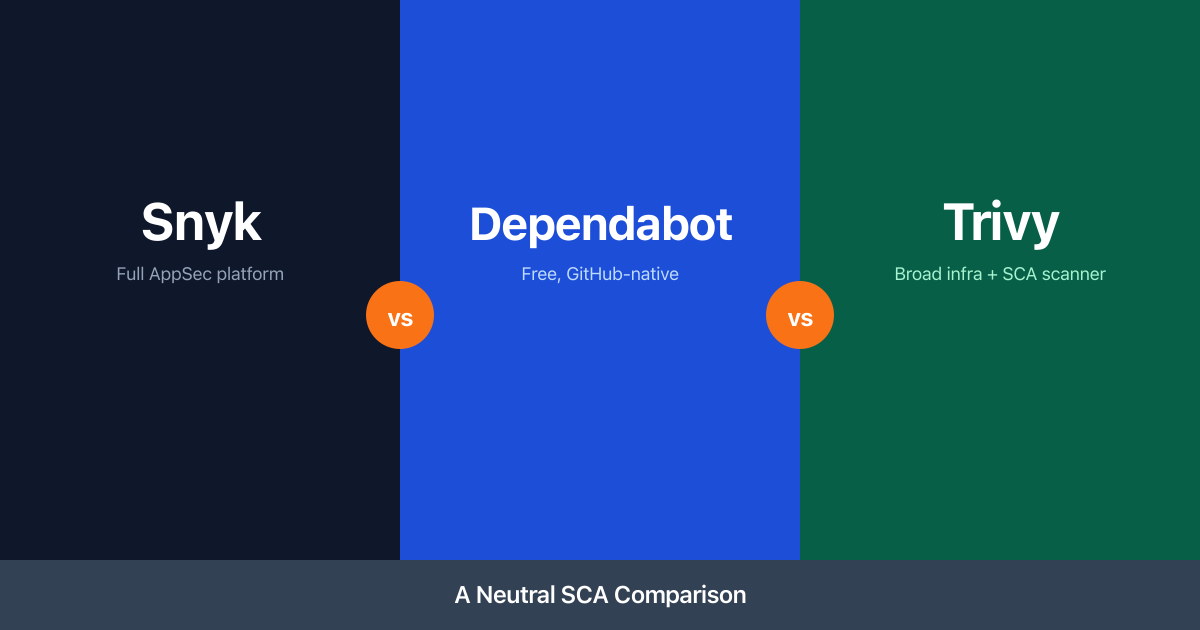
None of these three free-or-flat options replaces everything Snyk's Team or Enterprise tier bundles (SAST, container scanning, IaC, compliance controls, SSO). The pricing question that actually matters isn't "is Snyk expensive" in the abstract — it's whether your team needs the full AppSec bundle Snyk's price reflects, or specifically needs dependency-scanning prioritization, where cheaper and free options cover the same ground. For the full three-way breakdown including Trivy, see Snyk vs Dependabot vs Trivy: A Neutral SCA Comparison. For how Dependabot's free automated-PR model compares technically, see Dependabot vs GeekWala.
Frequently Asked Questions
Does Snyk offer a flat team rate instead of per-developer pricing?
Not at Team or Ignite. Both scale per contributing developer with no team-wide flat option; Snyk's public pricing page doesn't list a minimum seat count for Team. Only Enterprise pricing is custom-negotiated, and Snyk doesn't publish whether flat-rate arrangements are available there — that requires a sales conversation.
What exactly counts as a "contributing developer" for billing?
Per Snyk's own pricing page (accessed 2026-08-14), it's any developer who has made a commit to a private repository monitored by Snyk within the last 90 days. This is a rolling window, not a static headcount — someone who commits once and leaves still counts for the following 90 days.
Is Snyk's Free plan enough for a small team?
For evaluation or very light use, yes. For a team running snyk test in CI on every pull request across more than one or two active repos, the 200-test Open Source cap is usually the first limit hit — often within the first sprint of consistent CI usage, well before the 5-project cap becomes relevant.
Does GeekWala's $12/month Pro plan include SAST or container scanning?
No. GeekWala is a dependency (SCA) scanner only — npm, PyPI, Maven, Packagist, Go, crates.io, RubyGems, and NuGet. If SAST or container scanning are requirements, Snyk, Trivy, or a similar broader tool is the correct comparison, not GeekWala. See Free Dependency Scanning Tools in 2026 for the full landscape of tools by scope.
How current are the Snyk figures in this article?
Pulled directly from snyk.io/plans on 2026-08-14. Vendor pricing pages change without notice — verify current figures directly with Snyk before budgeting, particularly for Team-plan per-developer rates and Enterprise quotes, which are the figures most likely to move.
Snyk's per-developer pricing rewards small, focused security teams. GeekWala's flat rate rewards everyone else.
See GeekWala's Pro plan pricing → — flat $12/month regardless of team size, or scan a lock file free right now at our npm scanner. No account needed for a first look.