Trivy is the broader scanner — containers, filesystems, Kubernetes, Terraform, secrets, and licenses, in addition to dependencies. Grype is narrower and dependency/SBOM-focused, integrates natively with Syft, and ships EPSS and CISA KEV enrichment out of the box. If you're scanning infrastructure as well as application dependencies, Trivy's single-tool coverage wins. If you're specifically SBOM-and-dependency focused and want exploitation-signal prioritization without adding a second tool, Grype is the tighter fit.
Trivy and Grype are both free, open-source vulnerability scanners with real adoption in CI/CD pipelines — and teams evaluating one almost always end up asking about the other. This is a neutral, head-to-head comparison of the two tools as they actually work. Neither vendor is "the answer" for every team; the right pick depends on what you're scanning and how your pipeline is shaped.
In This Article
- What each tool is built for
- Feature-by-feature comparison
- Vulnerability data and prioritization signals
- CI/CD and offline fit
- Who should choose which
What Each Tool Is Built For
Trivy (Aqua Security) is a broad-scope scanner: container images, filesystems, Kubernetes manifests, and infrastructure-as-code (Terraform, CloudFormation) in a single binary, covering 20+ package ecosystems. Its design goal is "one scanner for everything in the deployment pipeline," and container image scanning is its most mature surface.
Grype (Anchore) is narrower and CLI-first: dependency and container vulnerability scanning built on top of Anchore's Syft SBOM generator. It integrates tightly with the Syft/CycloneDX SBOM ecosystem, supports offline/airgapped scanning against a local vulnerability database, and — unlike Trivy — ships native EPSS and CISA KEV enrichment without a plugin.
Feature Comparison
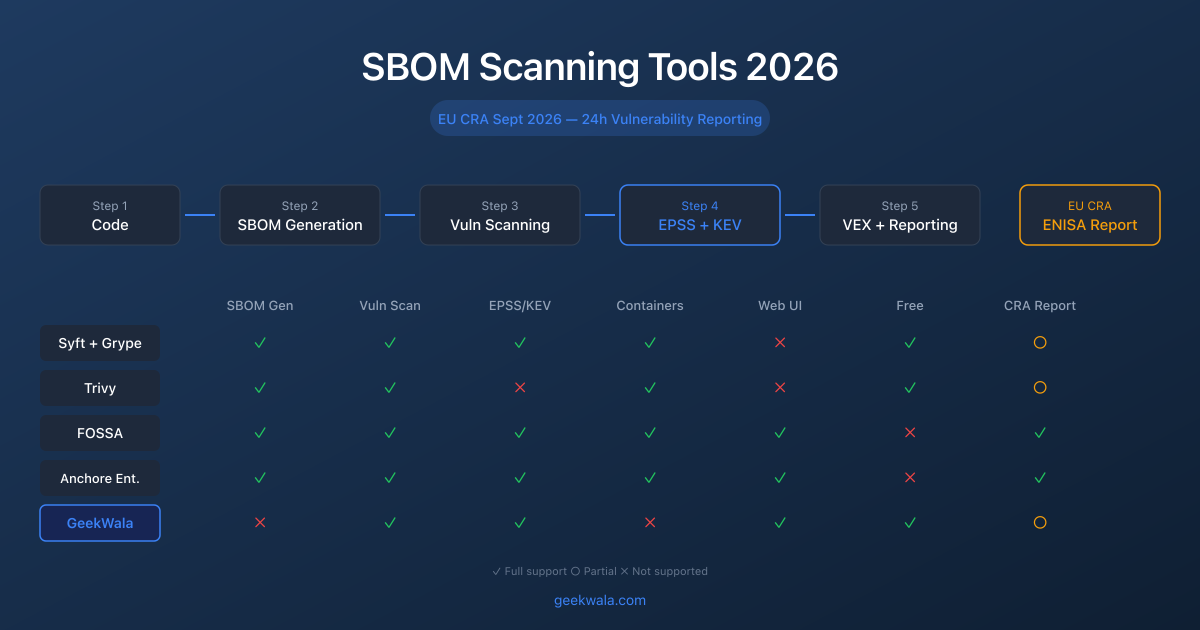
| Feature | Trivy | Grype |
|---|---|---|
| Container image scanning | Yes | Yes |
| IaC scanning (Terraform, CloudFormation, K8s manifests) | Yes | No |
| Filesystem scanning | Yes | Limited |
| SBOM generation | Via plugin | Native (Syft) |
| SBOM-native scanning (CycloneDX/SPDX input) | Yes | Yes (its primary design mode) |
| EPSS exploitation scores | Community plugin only, not built in | Native |
| CISA KEV flags | Not built in | Native |
| Ecosystems covered | 20+ (broadest) | Narrower, dependency + OS package focus |
| Offline / airgapped mode | Yes | Yes (local DB) |
| License | Apache 2.0 | Apache 2.0 |
Vulnerability Data and Prioritization
Both tools pull from open advisory sources (NVD, GitHub Security Advisories, and distro-specific feeds like Red Hat's OVAL data), so the underlying vulnerability data overlaps substantially. The real difference is what each tool does with that data once found.
Trivy reports CVEs with severity (Critical/High/Medium/Low) derived from CVSS. EPSS exploitation-probability scoring exists as a community plugin, not a built-in field — if you want it inside Trivy's own output, you're adding a third-party integration.
Grype ships EPSS and CISA KEV as native fields in its own output. If exploitation-aware triage — not just CVSS severity — matters to your workflow, Grype gives you that signal without extra tooling; Trivy requires the plugin to get the same view. (See what EPSS exploit-prediction scoring actually measures and the CISA KEV catalog explained if either signal is new to you.)
CI/CD and Offline Fit
Both are single-binary CLI tools that drop cleanly into GitHub Actions, GitLab CI, Jenkins, and most CI runners, and both support fully offline/airgapped operation against a pre-downloaded vulnerability database — a real requirement for regulated or air-gapped environments.
Where they diverge is scope of what you'd run in a single pipeline step. If your pipeline needs to scan a container image AND the Terraform that provisions it AND the Kubernetes manifests that deploy it, Trivy covers all three in one tool. If your pipeline is SBOM-centric — generate an SBOM with Syft, then scan it — Grype is purpose-built for that exact handoff.
Who Should Choose Which
Choose Trivy when:
- You need IaC scanning (Terraform, CloudFormation, Kubernetes manifests) alongside dependency and container scanning
- You want the broadest ecosystem coverage in one tool
- A single scanner for your entire pipeline, not a combination of tools, is the priority
Choose Grype when:
- Your workflow is already SBOM-centric (Syft-generated SBOMs feeding downstream scans)
- You want EPSS and CISA KEV natively, without adding a plugin
- Your primary surface is dependency and OS-level package vulnerabilities, not IaC
Use both when:
- Some teams run Trivy for IaC and container scanning and Grype for SBOM-driven dependency scanning specifically because they cover different parts of the same pipeline rather than competing for the same job.
Where GeekWala Fits
Both tools stop at detection — they tell you what CVEs exist and (in Grype's case natively, or via plugin in Trivy's) an exploitation-probability signal in their own CLI output. If you also want a web dashboard, scan history, and scheduled monitoring that a whole team can use without living in a terminal, that's a layer neither tool provides on its own — see the dedicated GeekWala vs Trivy and GeekWala vs Grype comparisons for the full feature and pricing breakdown against each. For the wider open-source landscape beyond these two, see 5 Ecosystem-Native Dependency Scanners Compared.
Frequently Asked Questions
Are Trivy and Grype both really free?
Yes — both are fully open source (Apache 2.0 license) with no paid tier, usage cap, or enterprise upsell for the CLI tool itself.
Can I use Trivy and Grype together?
Yes, and some teams do — Trivy for IaC/container breadth, Grype for SBOM-driven dependency scanning with native EPSS/KEV. They read overlapping but not identical vulnerability data, so running both can also serve as a cross-check.
Which has better container image scanning?
Both scan container images natively. Trivy has broader ecosystem and IaC coverage inside the same tool; Grype's container scanning is tightly coupled to its Syft SBOM generation step. For teams already using Syft, Grype's handoff is more direct; for teams that want one tool covering images, filesystems, and IaC, Trivy covers more surface.
Does either tool have a hosted dashboard?
No — both are CLI-first tools that output to the terminal, JSON, SARIF, or similar machine-readable formats for CI consumption. Neither ships a hosted web dashboard out of the box.