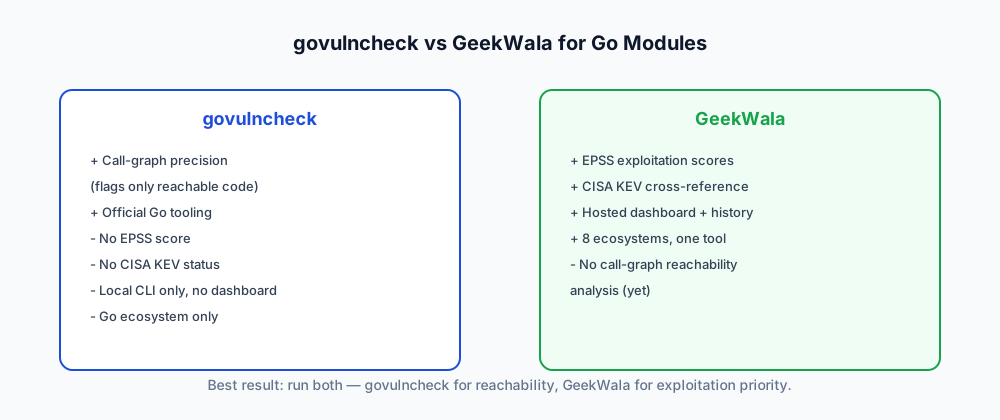
govulncheck is excellent for local development and CI — it checks your code against the official Go Vulnerability Database at vuln.go.dev. But it shows every vulnerability equally, without exploitation context. For production security, layer in EPSS (exploitation probability) and CISA KEV (confirmed active exploitation) to focus on findings that actually matter, and always scan against go.sum, not go.mod alone.
Your infrastructure service handles millions of requests daily. One of your microservices imports etcd-client, which imports go-yaml. A vulnerability in the YAML parser sits unpatched for three months because your team didn't know to check transitive dependencies. When the PoC drops, you're scrambling to patch.
Go's module system is one of the cleanest dependency ecosystems in programming. Semantic versioning enforcement, fast build times, transparent vendoring, and a single source of truth in go.mod. But a clean module system doesn't mean a secure one. Go's tooling — specifically govulncheck — provides excellent local vulnerability scanning. Yet in production systems with dozens of services and hundreds of transitive dependencies, it misses the signals that separate noise from actual exploitation risk. That's the same gap dependency vulnerability scanning as a discipline exists to close — enriching raw CVE matches with real-world exploitation signal.
Go teams face a different security landscape than Node or Python teams. There's no fragmented advisory database (the Go Vulnerability Database is authoritative and well-maintained). But there is the blind spot: govulncheck tells you "this dependency has a known vulnerability" without answering the production question: "Is anyone actually exploiting it right now?"
This guide shows you how to scan Go dependencies comprehensively, compare govulncheck with enriched scanning approaches, understand Go-specific vulnerability patterns, and build a practical security workflow for production Go systems.
What We'll Cover
- Go's module ecosystem and why it's different
- What files GeekWala scans for Go projects
- govulncheck vs GeekWala: comparison
- Go-specific vulnerability patterns
- Real-world examples of cascading Go vulnerabilities
- Building a Go dependency security workflow
- Priority decision tree for Go findings
- Best practices for Go supply chain security
Go Modules: Advantages and Hidden Complexity
Go's module system (introduced in Go 1.11, mandatory in Go 1.16+) is arguably the cleanest dependency model in programming. Some real advantages over npm and Python:
Single source of truth: go.mod and go.sum together represent the exact dependency tree in a way that npm's package-lock.json and Python's fragmented lock file ecosystem don't. Semantic versioning is enforced at the language level. Every build, CI run, and production deployment uses the same dependency tree.
Minimal version selection: Go's algorithm is deterministic. Given a go.mod with require module/a v1.5 and module a requires b v2.0, Go picks exactly b v2.0 — not the latest patch. This eliminates the "npm installed a different version in CI than production" surprises that plague JavaScript teams.
Efficient discovery: go mod graph shows your entire dependency tree. go mod why -m tells you why a package is included. Try doing that cleanly in npm or Python without tools.
But here's what Go teams miss:
Transitive vulnerabilities are invisible locally. You run go build daily. Your IDE warns you about compile errors. But govulncheck needs to be explicitly invoked. A vulnerability in a transitive dependency won't crash your build — it'll silently ship to production.
Indirect dependencies are easy to forget. Your go.mod might show 8 direct imports. But go mod graph shows 120 transitive ones. A vulnerability in google.golang.org/protobuf (used by almost everything) cascades through your entire system if it goes unnoticed.
go.sum entries balloon fast. A typical production service with 50 direct dependencies generates 1000+ lines in go.sum. This is good for security (immutable record) but bad for visibility — you can't easily tell what's new vs. what's been there for years.
The Go Vulnerability Database is conservative. It's well-maintained by the Go team, which is excellent. But it's smaller than the NVD (National Vulnerability Database). Some vulnerabilities appear in NVD before reaching the Go DB, and others only in the Go DB because they're Go-specific. Multi-source scanning catches more.
What Dependency Files GeekWala Scans for Go
GeekWala scans two Go files:
| File | What it gives the scan |
|---|---|
go.sum | Exact versions of every module the build uses — strongly recommended |
go.mod | Your requirements and their versions; since Go 1.17 it also lists indirect requirements |
Best practice: Always commit go.sum to version control. Without it, scanning against abstract version specs like github.com/lib/pq v1.x.x can't determine exact vulnerability matches. Different environments might resolve to different patch versions, and scanning becomes unreliable.
Workspace projects: a Go workspace (go.work, Go 1.18+) keeps one go.mod and go.sum per module, and there is no single workspace-level file to upload — scan each module's go.sum.
Vendor directories: vendoring doesn't change results. GeekWala reads go.sum, not the vendor/ tree, so the lock file stays the source of truth.
Transitive dependencies: go.sum lists indirect modules too, so GeekWala checks them along with your direct requirements. It reports which module is vulnerable, not the chain that pulled it in; go mod why -m <module> shows that chain, which tells you whether to upgrade the direct dependency or require the fixed version yourself.
govulncheck vs GeekWala: When Each Tool Makes Sense
govulncheck is the official Go vulnerability scanner. It integrates directly with the Go toolchain and uses the authoritative Go Vulnerability Database. It's lightweight, runs offline, and requires no third-party services.
govulncheck's real strengths: It only flags vulnerabilities that affect your code. Example: if a package has a vulnerability in a function you don't call, govulncheck doesn't report it (with caveats for interface methods and type assertions). This reduces noise compared to tools that report all vulnerabilities in all dependencies. For local development, this is powerful.
| Capability | govulncheck | GeekWala |
|---|---|---|
| Advisory sources | Go Vulnerability Database (official) | OSV, which includes the Go database, + EPSS + CISA KEV |
| Workspace projects | ✓ native | ⚠️ per module via go.sum (go.work isn't read) |
| Offline scanning | ✓ (downloads once, works offline) | ✗ (queries external APIs) |
| Exploitation signals | ✗ (no EPSS or KEV) | EPSS + CISA KEV |
| Transitive path tracing | ✓ (shows call chain) | ✗ (names the vulnerable module; go mod why -m shows the chain) |
| Unused dependency detection | ✓ (go mod tidy integration) | ✗ |
| Historical trend tracking | ✗ | ✓ (per-project vulnerability history; EPSS shown is today's) |
| Integration with CI/CD | ✓ native (part of Go toolchain) | ✓ via API/webhooks |
| Blast radius analysis | ✗ | ✗ (no call-graph or impact analysis; judge blast radius yourself) |
Use govulncheck for:
- Local development:
govulncheck ./...before committing - CI pipelines: Quick, offline validation
- Policy enforcement: Fail builds if vulnerabilities affect your code
- Real-time feedback: IDE integration with
gopls
Use GeekWala for:
- Production monitoring: Scheduled re-scans (Pro) with EPSS and KEV enrichment
- Supply chain risk: Understand which vulnerabilities are being actively exploited
- Cross-service coordination: Monitor dozens of microservices from a single dashboard
- Trend analysis: See how your project's vulnerability counts change over time
- Database coverage: OSV aggregates GitHub Security Advisories alongside the Go database, so you see both in one scan
Go-Specific Vulnerability Patterns: What Scanners Miss
Go's type safety and memory safety eliminate entire vulnerability categories. But Go has its own unique patterns that generic scanners struggle with:
| Category | Coverage by tools | Example packages | Priority signal |
|---|---|---|---|
| CGo unsafe code (C/C++ bindings) | Partial (NVD + Go DB) | libsodium binding, cgo calls | EPSS critical |
| Crypto implementation bugs (weak algorithms, timing attacks) | Full (Go DB excellent) | crypto/*, hash, encoding | EPSS + KEV |
| net/http vulns (request parsing, header handling) | Full (Go DB excellent) | net/http, middleware | EPSS + KEV (blast radius) |
| Protocol parsing (JSON, Protobuf) | Full (Go DB) | encoding/*, fmt, strconv | Context |
| Injection attacks (SQL, HTML, XML) | Full (Go DB) | sql, html/template, xml | EPSS + KEV |
| Race conditions (goroutine safety) | Rare (needs code review) | sync/*, channels | Context (hard to exploit) |
| Denial of service (ReDoS, panic) | Sometimes (Go DB inconsistent) | strings, regexp, container | EPSS |
| Supply chain (typosquatting, module injection) | No (vigilance) | Dependency confusion, typos | Code review |
Key insight: Go's standard library is large and well-maintained. A vulnerability in crypto/sha1 or net/http has enormous blast radius because Go favors stdlib over third-party packages where possible. When a stdlib vulnerability appears, treat it as critical regardless of CVSS — everyone is affected.
CGo is the exception: Go's safety guarantees end where C begins. Any package using CGo (import "C") to wrap C libraries inherits C's vulnerability surface. A cgo package calling libssl can have buffer overflows that violate Go's memory safety. Tools need to flag cgo packages and check their C dependencies—the Go DB does this, but it's worth double-checking with NVD.
Real-World Go Vulnerability Cascades
Vulnerabilities rarely stay confined to a single package:
Example 1: go-yaml under a library you chose (illustrative)
go-yaml (gopkg.in/yaml.v2) before 2.2.8 has CVE-2019-11254: crafted YAML makes the parser consume excessive CPU and memory, a denial of service. If a library you depend on still pins an old yaml.v2, your stack looks like this:
your-service/
├── go.mod
│   ├── config-lib v1.4.0  ← you chose
│   │   └── yaml.v2 v2.2.7 ← transitive
│   │       └── 🔴 CVE-2019-11254
│   └── grpc v1.42.0
│       └── protobuf v1.27.0
└── ...
govulncheck ./... reports it as affecting you when your code can reach the vulnerable parser — here, through config-lib's exported functions, which parse YAML internally. The vulnerability affects your code even though you never import go-yaml. To fix it, upgrade config-lib to a release that requires yaml.v2 2.2.8 or later; if none exists yet, require gopkg.in/yaml.v2 v2.2.8 in your own go.mod and Go's minimal version selection uses it.
Example 2: a net/http denial of service under every framework
In 2021, Go's net/http had CVE-2021-31525: an oversized header could make ReadRequest or ReadResponse panic and crash the server (fixed in Go 1.15.12 and 1.16.4). Every Go web service built with an earlier release was exposed, whichever framework it used:
web-service/
├── go.mod
│   ├── gin v1.7.0    ← web framework
│   │   └── net/http  ← stdlib
│   │       └── 🔴 CVE-2021-31525
│   ├── echo v4.3.0
│   │   └── net/http
│   │       └── 🔴 CVE-2021-31525
│   └── grpc v1.39.0
│       └── net/http
│           └── 🔴 CVE-2021-31525
The same stdlib flaw sat under all three frameworks. Patching was straightforward (upgrade Go), but knowing the blast radius mattered.
Example 3: Kubernetes client-go and dependencies
An API server built on client-go (the Kubernetes API library) and the etcd client. The golang.org/x/* modules are pinned by commit, not by release, so they are easy to leave behind:
api-server/
├── k8s.io/client-go v0.24.0
│   └── golang.org/x/net (Jan 2022)
│       ├── 🔴 CVE-2022-27664 (HTTP/2 DoS)
│       ├── golang.org/x/sys (Dec 2021)
│       │   └── 🔴 CVE-2022-29526
│       └── golang.org/x/text v0.3.7
└── go.etcd.io/etcd/client/v3 v3.5.0
    └── go.uber.org/zap v1.17.0
        └── ... more packages
A single client-go upgrade might cascade through 15+ transitive updates. Without proper dependency visibility, you might miss a critical fix buried three levels deep.
Building a Go Dependency Security Workflow
Step 1: Generate and maintain your dependency lock file
# Initialize modules (if new project)
go mod init github.com/myorg/myservice

# Add all dependencies
go get ./...

# Ensure go.sum is complete
go mod tidy

# Commit both files
git add go.mod go.sum
git commit -m "feat: add dependency management"
Always commit go.sum. It's your source of truth. Without it, builds are non-deterministic.
Step 2: Run govulncheck locally
# Check your code and dependencies
govulncheck ./...

# In CI, fail the build on any findings
if ! govulncheck ./... ; then
  exit 1
fi
govulncheck is fast, offline, and accurate for local development. Use it first.
Step 3: Upload to GeekWala for enriched scanning
Visit GeekWala's Go scanning page and upload your go.mod and go.sum. GeekWala parses them, checks each module against OSV (which includes the Go vulnerability database), and adds EPSS and CISA KEV to every finding.
Step 4: Interpret the results with Go-specific context
GeekWala enriches each finding with three signals: CVSS (severity), EPSS (exploitation probability), and CISA KEV (confirmed active exploitation).
For Go specifically, start from the standard EPSS/KEV priority (see the EPSS deep dive), then layer in these additional factors:
- Is this a stdlib vulnerability? (
net/http,crypto/*,encoding/*) - Is this a cgo package? (check with
go list -jsonor GitHub) - What's the blast radius? (how many services depend on this?)
Examples:
net/httpvuln, EPSS 0.3, CVSS 5.0, stdlib: yes → bump to "patch this week" (stdlib = everyone affected).- obscure-pkg vuln, EPSS 0.3, CVSS 5.0, blast: low → keep at "standard cycle" (small blast radius).
- etcd vuln, EPSS 0.6, CVSS 6.5, blast: high (Kubernetes ecosystem) → "patch this week" (high EPSS + widely used).
Step 5: Set up continuous monitoring
For production services, configure automated scans:
# Daily scan via cron or scheduled job
0 2 * * * /usr/local/bin/govulncheck ./... >> /var/log/vulnscan.log

# Or schedule GeekWala re-scans (Pro) and point its scan.completed webhook
# at your own Slack relay. After every scan GeekWala sends:
# POST <your webhook URL>
# {
#   "event": "scan.completed",
#   "data": {
#     "project": { "name": "api-server" },
#     "summary": { ... },
#     "comparison": { ... }   # new and resolved vulnerabilities vs the previous scan
#   }
# }
Prioritizing Go Vulnerabilities: A Decision Framework
You've scanned your dependencies. You have 15 vulnerabilities. Where do you start?
This Go-specific tree differs from the default EPSS ladder in the 3-Signal triage guide in three ways: stdlib vulnerabilities and CGo packages move up the queue regardless of EPSS, the deadlines are coarser (now, this week, soon, 2-4 weeks, next quarter), and a reachability check with govulncheck decides the deadline for everything else. The guide's ladder stays the default if you want one policy across ecosystems.
- CISA KEV (actively exploited)? Yes: PATCH NOW (drop everything). No: continue to step 2.
- Stdlib vulnerability (
net/http,crypto/*,encoding/*, etc.)? Yes: PATCH THIS WEEK (affects everyone). No: continue to step 3. - High EPSS (> 0.8)? Yes: PATCH THIS WEEK. No: continue to step 4.
- CGo package (C bindings)? Yes: PATCH SOON (memory safety risks). No: continue to step 5.
- Does your code hit the affected code path? Yes: PATCH STANDARD CYCLE (2-4 weeks). No: PATCH MAINTENANCE CYCLE (next quarter); use the govulncheck call graph to determine this.
Worked examples (hypothetical findings):
- A net/http flaw on CISA KEV (stdlib, EPSS 0.7): Deploy patch in 2-4 hours. This affects production immediately.
- obscure-json-parser DoS (EPSS 0.2, blast: low): Queue for next maintenance window. Monitor for EPSS spikes.
- grpc reflection info leak (EPSS 0.5, you don't expose reflection): Patch in 2 weeks, not emergency. Understand your threat model.
Best Practices for Go Supply Chain Security
1. Always commit go.sum
Your go.sum is your security artifact. It proves your builds use the exact dependencies you tested. Attackers can modify go.mod without modifying go.sum (in some scenarios), so the Go toolchain validates checksums against go.sum. Commit it.
2. Use go.mod tidy in CI
# Ensure no unused or extra dependencies
go mod tidy

# Fail if go.mod or go.sum changed
if git diff --exit-code go.mod go.sum ; then
  echo "Dependencies changed!"
  exit 1
fi
This catches accidental dependency additions and forces intentional review.
3. Audit third-party imports
Go's import paths are URLs, which means typosquatting is possible:
// Correct:
import "github.com/google/uuid"

// Typosquatted (real attack):
import "github.com/googel/uuid"  // Slight misspelling
import "google.com/uuid"          // Different domain
Code review should catch these, but tools can help:
go list -m -u all # Show all imports and available updates
4. Monitor transitive dependencies aggressively
Go's transitive chains are deep and invisible. Use go mod graph to understand your supply chain:
go mod graph | grep etcd     # Find all paths to etcd
go mod why -m github.com/... # Why is this included?
For critical services, maintain a list of high-impact packages and check them monthly:
Critical Go packages (a vulnerability here is urgent):
net/http: stdlib, used by everythingcrypto/*: stdlib, cryptographic operationsencoding/*: stdlib, parsing and serializationgolang.org/x/net: quasi-stdlib, security-sensitivegrpc: 50% of microservicesetcd-client: Kubernetes ecosystemsql: database operations, injection risk
5. Patch fast for stdlib, carefully for everything else
Stdlib vulnerabilities require emergency patching (upgrade Go). Application package vulnerabilities require more care — test in staging first, because newer versions sometimes break APIs:
# For stdlib fixes: upgrade Go ASAP
# For app packages: test carefully

# Test the update in a branch
go get -u github.com/lib/pq  # For example
go test ./...                 # Run tests
# ... staging tests
# Then merge and deploy
6. Rotate credentials and audit access logs after supply chain attacks
If a dependency you use is compromised, assume the worst:
- Rotate credentials that the service uses
- Audit deploy logs to see if compromise was exploited
- Check application logs for anomalous behavior
Go's module checksums validate integrity (no modification in transit), but they don't protect against malicious upstream sources.
7. Enable dependabot or renovate for continuous updates
Automate dependency updates so you're not running multi-month-old versions:
# .github/dependabot.yml
version: 2
updates:
  - package-ecosystem: "gomod"
    directory: "/"
    schedule:
      interval: "weekly"
    open-pull-requests-limit: 5
This opens PRs for updates. CI runs tests. You review and merge. No manual lock file management.
Frequently Asked Questions
Does govulncheck catch vulnerabilities in indirect dependencies?
Yes, with an important caveat. govulncheck ./... will flag any vulnerability in any dependency (direct or transitive) if your code's execution path might reach it. But with caveats: if a dependency exports a method that calls vulnerable code, and you call that method, govulncheck flags it. But if you call the exported method without hitting the vulnerable code path, govulncheck might not flag it (though this is rare). Use govulncheck call graphs for detailed analysis.
Can I use go get to patch a transitive dependency directly?
Not easily. If you want to force a specific version of a transitive dependency, you add a require directive to go.mod:
require (
  github.com/lib/pq v1.10.0           // Direct dependency
  golang.org/x/net v0.0.0             // Forced version (transitive)
)
Then run go mod tidy. But this is a band-aid — the better fix is to update the parent package that brings in the vulnerable transitive dependency. Talk to the parent package maintainers, or consider forking if they're unresponsive.
What's the difference between go.mod and go.sum for scanning?
go.mod declares version constraints. go.sum records exact hashes. For scanning, go.sum is authoritative — it represents what actually gets built. If you only have go.mod, scanners must resolve versions (which might resolve differently in different environments). Always scan with both files.
My service imports a package that's already deprecated. Is that urgent?
Not immediately, but it's a ticking clock. Deprecated packages stop receiving security patches. Check if there's a recommended replacement. Plan a migration. Don't let deprecated packages accumulate — each one is a future vulnerability waiting to happen. The Go team is good about this (e.g., io/ioutil → os), so follow their guidance.
How do I handle a vulnerability in a package I use but don't directly control?
File an issue on the package's GitHub repo. Provide:
- CVE ID and Go Vulnerability Database link
- EPSS score and KEV status
- Timeline for patching
- Whether you have a workaround
If the maintainer is unresponsive for 30+ days, consider:
- Using a fork with the patch backported
- Replacing the package with an alternative
- Mitigating the vulnerability in your code (e.g., input validation)
Can I rely on GitHub's dependency alerts instead of GeekWala?
GitHub's Dependabot alerts are good for initial discovery. They show an EPSS score on each alert, but they can't be filtered or sorted by CISA KEV, the catalog that confirms exploitation in the wild. If you're managing a large microservice infrastructure with hundreds of dependencies, Dependabot alerts will overwhelm you. GeekWala's EPSS/KEV enrichment makes it actionable.
What if a vulnerability appears in NVD but not in the Go Vulnerability Database?
This happens occasionally for non-Go packages. The Go DB is conservative and curated by the Go team — they only include vulnerabilities that affect Go code. If a C library has a vulnerability but you're not using CGo to call it, the Go DB might not list it. Use govulncheck for Go-specific coverage. To cross-check against NVD, run govulncheck -json ./... to get machine-readable output you can compare against the NVD API programmatically.
Does GeekWala support Go workspaces (go 1.18+)?
Partly. GeekWala doesn't read go.work, and a workspace has no single workspace-level file to upload. Scan each module's go.sum (or go.mod) on its own, which is still useful for monorepos with shared dependencies across multiple services.
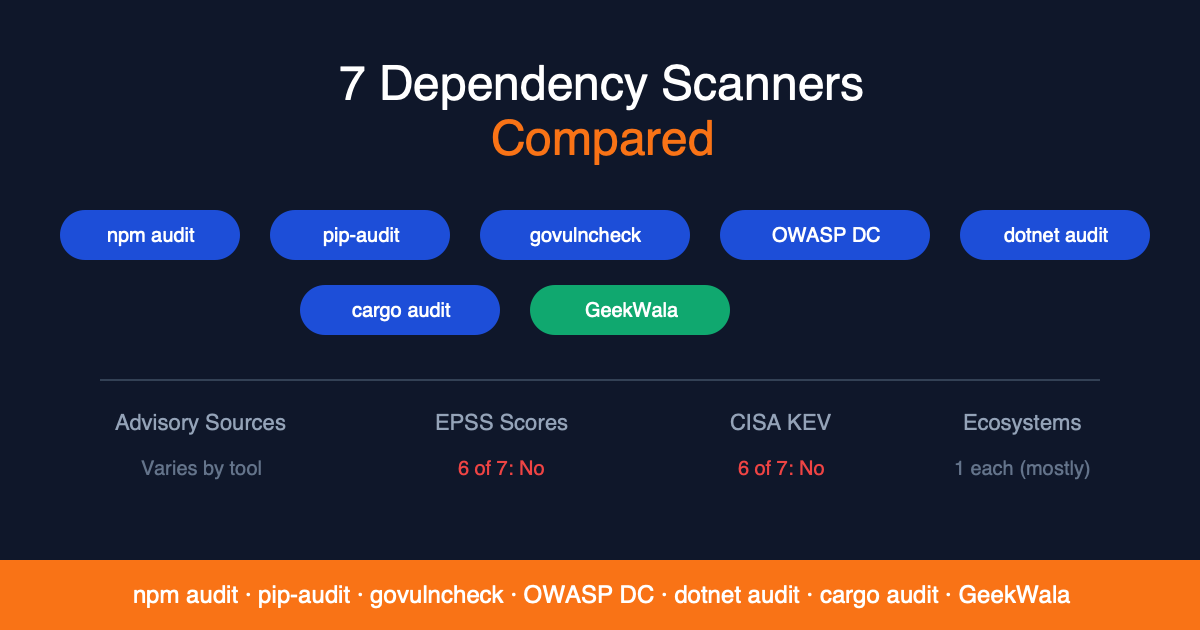
For a side-by-side comparison of all ecosystem scanners, see 7 Dependency Vulnerability Scanners Compared.
Protect your Go services from the vulnerabilities that matter—not the ones that fill your inbox.
Scan your Go dependencies and get EPSS + CISA KEV prioritization → — upload your go.mod and go.sum in seconds, understand which findings are actually being exploited, and build a production-ready vulnerability workflow. No account needed for up to 10 packages.