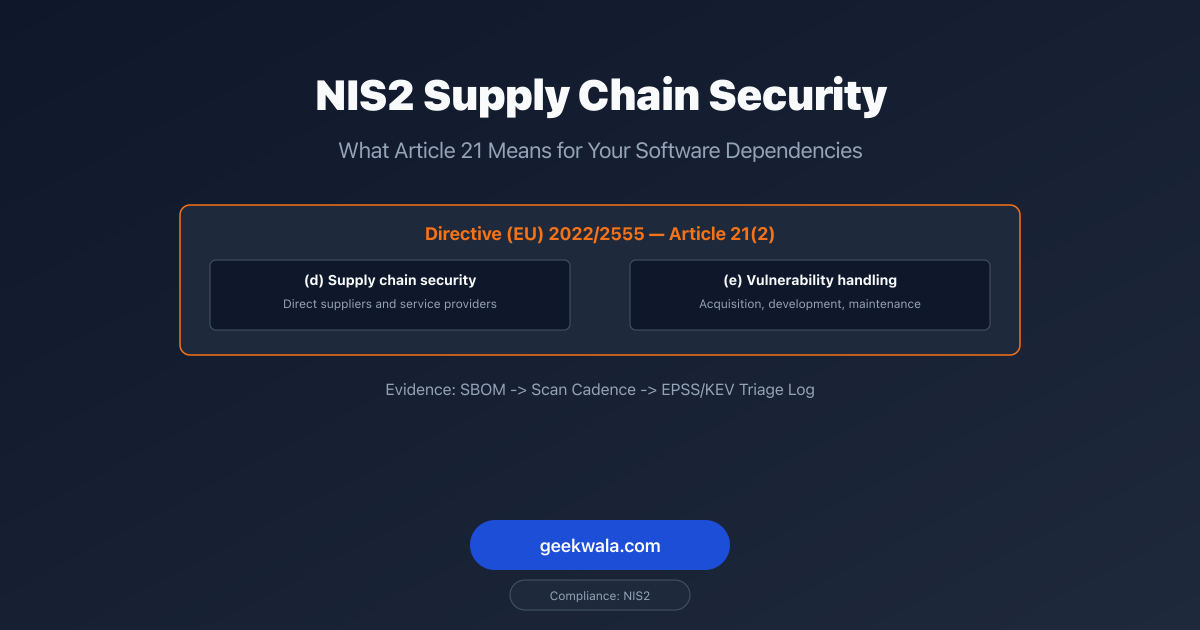
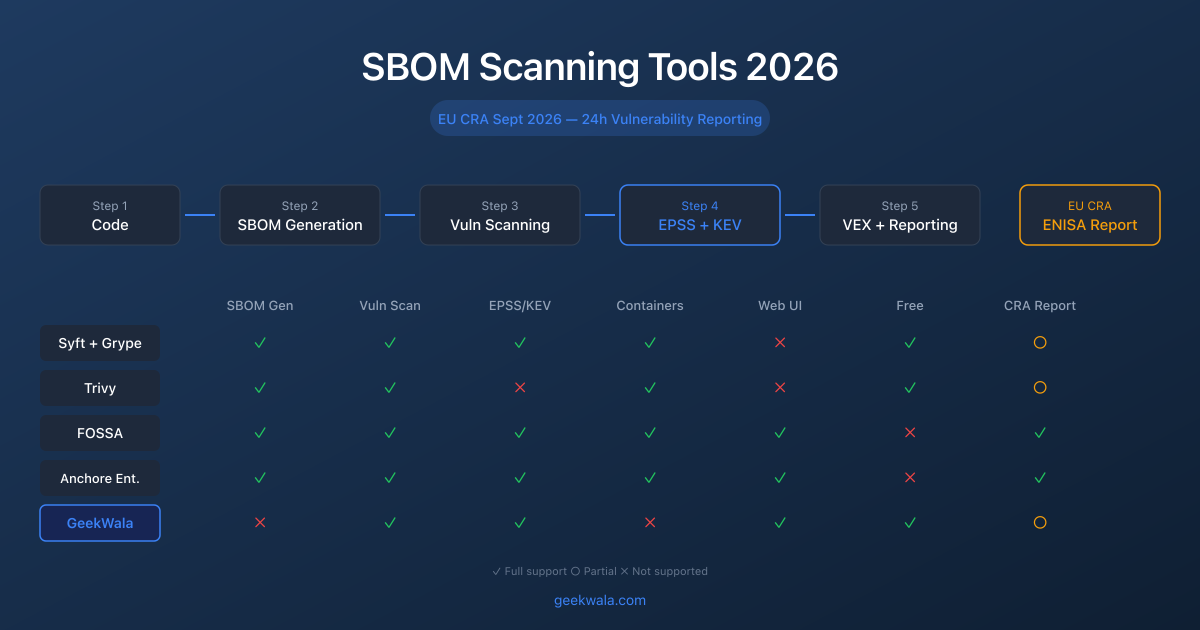
Software supply chain attacks more than doubled in 2025, most often through compromised dependencies rather than an organization's own code. This guide covers the practical layers that actually stop them: dependency scanning, SBOM generation, EPSS-based vulnerability triage, and CI/CD hardening.
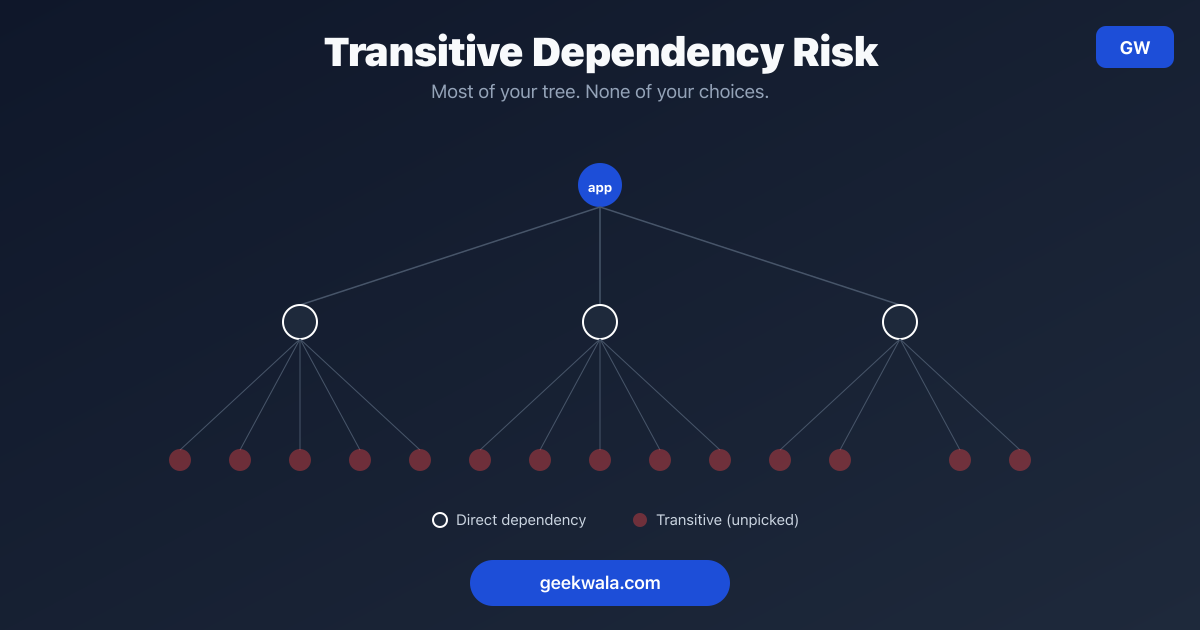
A developer on your team installs a package. It pulls in 47 transitive dependencies. One of those dependencies — three layers deep — had its maintainer's npm account compromised last week. Your CI builds pass. Your tests are green. The backdoor ships to production inside a signed artifact.
This isn't hypothetical. Software supply chain attacks more than doubled in 2025. The attack surface isn't your code — it's everyone else's code that your code depends on.
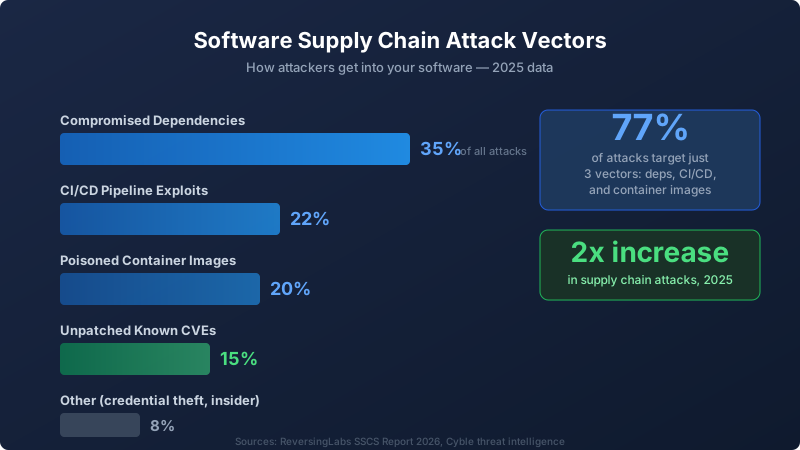
I've spent the last two years building dependency scanning tools, and the pattern I see repeatedly is teams treating supply chain security like a checkbox. They run npm audit, ignore the output, and move on. This guide covers what actually works — not the theoretical framework, but the concrete steps that stop compromised dependencies from reaching production. Dependency scanning — matching your packages against known vulnerabilities, explained in full in what dependency vulnerability scanning is — is the first of those layers, and the one most teams already have some version of.
What "Software Supply Chain" Actually Means
Your software supply chain is every external component that becomes part of your shipped product. That includes:
- Direct dependencies you declare in
package.json,requirements.txt,go.mod, orpom.xml - Transitive dependencies pulled in by your direct dependencies (often 10-50x more numerous)
- Build tools and CI/CD infrastructure — compilers, linters, test frameworks, GitHub Actions
- Container base images and OS-level packages
- Development tools — IDE plugins, code generators, AI coding assistants
Most teams only think about the first bullet. The 2025 attack data tells a different story: dependencies, CI/CD pipelines, and container images — not bugs in your own code — are where the volume concentrates, a ranking OWASP's Top 10 2025 Software Supply Chain Failures category corroborates at a categorical level.
The Five Attack Vectors You're Exposed To
Not all supply chain attacks work the same way. Understanding the vectors helps you prioritize defenses.
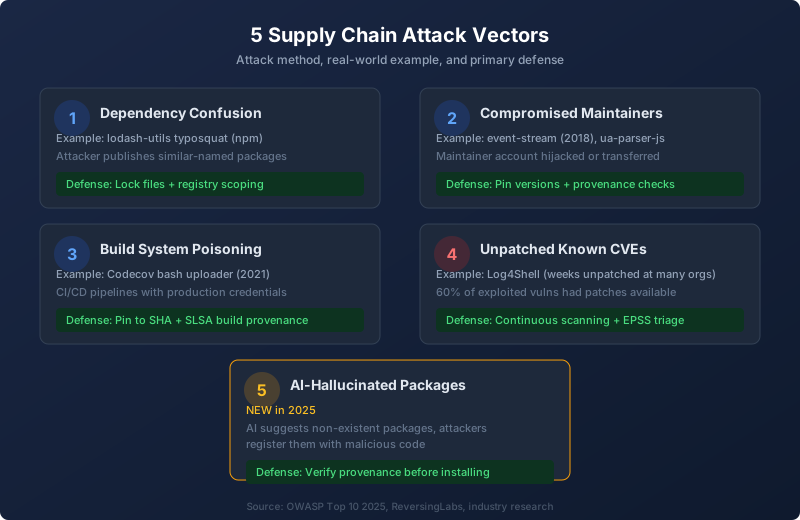
1. Dependency Confusion and Typosquatting
An attacker publishes lodash-utils (note the dash) to npm. Your developer types the wrong package name. Or worse — the attacker registers your internal package name on a public registry, and your build system pulls the public version instead of your private one.
Defense: Lock files (package-lock.json, poetry.lock), registry scoping for internal packages, and continuous scanning for known malicious packages.
2. Compromised Maintainer Accounts
The event-stream attack in 2018 pioneered this. A maintainer transfers ownership to a stranger who injects cryptocurrency-stealing code. It happened again with ua-parser-js in 2021, colors in 2022, and multiple npm packages through 2025. Attackers now target maintainers with phishing specifically crafted for open-source contributors.
Defense: Pin exact dependency versions (not ranges), verify package provenance when available, monitor for unexpected version bumps.
3. Build System Poisoning
Your GitHub Actions workflow uses actions/checkout@v3. But what if the action's repository gets compromised? Or what if a malicious PR modifies your CI config to exfiltrate secrets? Build systems are high-value targets because they have access to signing keys, deployment credentials, and production infrastructure.
Defense: Pin actions to SHA hashes (not tags), restrict workflow permissions with permissions: blocks, use SLSA-compliant build systems.
4. Known Vulnerabilities Left Unpatched
This is the unsexy one. No zero-day, no sophisticated attack — just a CVE published in March that's still unpatched in September. Over 60% of exploited vulnerabilities had patches available before the exploit was used in the wild.
Defense: Continuous dependency scanning with exploitation-aware prioritization. Not all CVEs are equal — focus on the ones attackers are actually using. EPSS scores tell you which vulnerabilities have real exploit activity, so you patch the dangerous few percent first instead of drowning in the overwhelming majority that never get used.
5. Malicious Code in AI-Generated Dependencies
This one's new. AI coding assistants sometimes suggest packages that don't exist — "hallucinated" package names. Attackers have started registering these phantom packages with malicious code, knowing that other AI users (or the same user trusting autocomplete) will install them.
Defense: Verify every AI-suggested package exists and has legitimate provenance before installing. Run your AI-generated dependency lists through a scanner before npm install.
Layer 1: Dependency Scanning — Your First Line of Defense
Dependency scanning is the foundation. Without it, you're flying blind.
A good scanner does three things:
- Parses your dependency manifest (lock files, not just declared dependencies) to build a complete picture including transitive dependencies
- Matches packages against vulnerability databases — OSV, NVD, GitHub Security Advisories, and ecosystem-specific sources
- Enriches findings with exploitation context — not just "is there a CVE?" but "is anyone actually exploiting this CVE?"
That third point matters more than most teams realize. A typical scan of a medium-sized project returns 50-200 vulnerability findings. Without prioritization, your team either patches everything (impossible), patches by CVSS score (inefficient — most critical CVEs are never exploited), or ignores the results entirely (dangerous).
GeekWala approaches this by combining three signals: CVSS severity, EPSS exploitation probability, and CISA KEV (Known Exploited Vulnerabilities) status. The result is a 3-signal triage method that cuts alert noise by roughly 80% while ensuring you never miss a vulnerability that attackers are actively using. Run a scan to see this triage applied to your own dependency tree.
What to Look for in a Scanner
- Ecosystem breadth. Your project probably uses more than one language. A scanner that covers npm but not PyPI leaves gaps.
- Transitive dependency resolution. Scanning
package.jsonwithout resolvingpackage-lock.jsonmisses 80% of your actual dependency surface. - Continuous monitoring. Point-in-time scans go stale within days. New CVEs are published constantly — you need scans that alert you when a new vulnerability affects a dependency you already use.
- Low false-positive rate. If your scanner cries wolf on every informational CVE, your team will stop reading the results.
Layer 2: SBOM Generation and Management
A Software Bill of Materials (SBOM) is an inventory of every component in your software. Think of it as the ingredient list on packaged food — except for code.
SBOMs aren't just a nice-to-have anymore. The EU Cyber Resilience Act requires vulnerability reporting capabilities by September 2026 and full SBOM documentation by December 2027. The U.S. federal government already requires SBOMs from software vendors. We've written a practical checklist for SBOM compliance if you need the specific requirements.
SBOM Formats
Two formats dominate:
- CycloneDX — designed for security use cases, includes vulnerability and licensing data natively. Preferred by most security tools.
- SPDX — Linux Foundation standard, broader scope including legal compliance. Required by some government procurement processes.
Pick one and generate it automatically in your CI pipeline. Don't hand-maintain SBOMs — they go stale immediately.
Practical SBOM Generation
# CycloneDX for Node.js projects
npx @cyclonedx/cyclonedx-npm --output-file sbom.json

# CycloneDX for Python
pip install cyclonedx-bom
cyclonedx-py environment --output sbom.json

# SPDX via Syft (multi-ecosystem)
syft . -o spdx-json > sbom.spdx.json
Generate your SBOM in CI on every release. Store it as a build artifact. When a new CVE drops, you can instantly query which of your deployed versions contain the affected package — instead of grepping lock files across 50 repositories.
Layer 3: Vulnerability Triage — Focus on What's Actually Exploited
Here's the uncomfortable truth: at most about 6% of CVEs are ever exploited in the wild — and stricter datasets put it nearer 1–2%. The rest are theoretical risks that will never become actual attacks. Patching by CVSS score alone means your team spends 80% of its effort on vulnerabilities that don't matter while potentially missing the ones that do.

The fix is exploitation-aware triage. Combine these three signals:
| Signal | What It Tells You | Source |
|---|---|---|
| CVSS | How bad could it be (severity) | NVD, vendor advisories |
| EPSS | How likely it will be exploited (probability) | FIRST.org, updated daily |
| CISA KEV | Is it already being exploited (confirmed) | CISA, updated as threats emerge |
A vulnerability with CVSS 9.8 but EPSS 0.1% and no KEV listing? It's scary on paper but nobody's exploiting it. Queue it for your next maintenance cycle.
A vulnerability with CVSS 7.5, EPSS 85%, and a KEV listing? Drop everything. That one is being used in active attacks right now.
This isn't just theory. Teams using exploitation-aware triage report resolving critical vulnerabilities 3-5x faster because they're not buried under noise.
Layer 4: CI/CD Pipeline Hardening
Your build pipeline has production credentials. Your deployment scripts push to live servers. If an attacker compromises your CI/CD, they don't need a vulnerability in your code — they can inject whatever they want directly into your build output.
GitHub Actions Security Checklist
# Pin actions to commit SHAs, not tags
- uses: actions/checkout@a5ac7e51b41094c92402da3b24376905380afc29 # v4.1.6

# Restrict permissions to minimum needed
permissions:
  contents: read
  packages: write

# Don't allow PRs from forks to access secrets
# (GitHub does this by default for public repos)
Broader CI/CD Hardening Steps
- Restrict who can modify CI configuration. Your
.github/workflows/directory should require code review from a security-aware team member. - Separate build and deploy credentials. A compromised build step shouldn't give access to production deployment keys.
- Enable artifact signing. SLSA (Supply-chain Levels for Software Artifacts) provides a framework for verifying that build artifacts haven't been tampered with.
- Audit third-party CI integrations. Every GitHub App, webhook, and integration with access to your repos is an attack surface.
Layer 5: Organizational Maturity
Technical controls only work if your team actually uses them. Here's a maturity model you can use to assess where you stand.
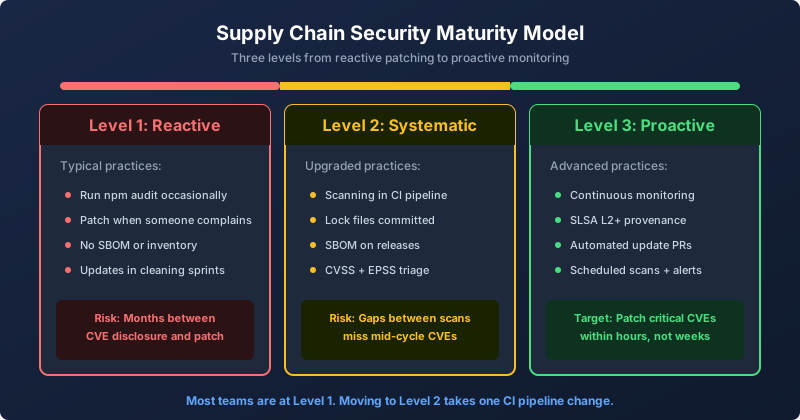
Level 1: Reactive (Most Teams Start Here)
- Run
npm auditoccasionally - Patch vulnerabilities when someone complains
- No SBOM, no inventory of what's deployed
- Dependency updates happen during "spring cleaning" sprints
Level 2: Systematic
- Automated dependency scanning in CI (blocks merges on critical findings)
- Lock files committed and reviewed
- SBOM generated on releases
- Vulnerability triage uses CVSS + EPSS (not just CVSS alone)
- Monthly dependency update cadence
Level 3: Proactive
- Continuous monitoring with alerts for new CVEs affecting deployed software
- SLSA Level 2+ build provenance
- Automated dependency update PRs with CI validation
- SBOM stored as build artifacts with historical tracking
- Supply chain risk assessment for new dependencies before adoption
- Scheduled scans catch regressions between code changes
Where to Start
If you're at Level 1, don't try to jump to Level 3. Start with these three actions:
- Add a dependency scanner to your CI pipeline. Block merges when it finds vulnerabilities with EPSS scores above 10% or any CISA KEV listing. GeekWala can scan across 8 ecosystems — npm, PyPI, Maven, Go, Packagist, crates.io, RubyGems, and NuGet — with EPSS and KEV enrichment out of the box.
- Commit your lock files. If your team doesn't commit
package-lock.jsonorpoetry.lock, fix that today. It's the single lowest-effort, highest-impact supply chain security step. - Generate an SBOM in your next release. Even if nobody asks for it yet, having the data ready is the foundation for everything else.
FAQ
Do I need to worry about supply chain security if I only use popular, well-maintained packages?
Yes. Popularity doesn't equal security. The event-stream attack targeted a package with millions of weekly downloads. Popular packages are actually higher-value targets because compromising one package reaches more victims. The defense isn't avoiding dependencies — it's scanning, monitoring, and triaging continuously.
What's the difference between SCA and dependency scanning?
Software Composition Analysis (SCA) is the broader category. Dependency scanning is a subset of SCA that specifically focuses on finding known vulnerabilities in your project's dependencies. Full SCA may also include license compliance, code similarity detection, and outdated component identification. For most development teams, dependency scanning with vulnerability enrichment covers the critical security use case.
How often should I scan my dependencies?
At minimum, scan on every CI build and set up continuous monitoring for new CVE disclosures. A vulnerability disclosed on Tuesday affects your code deployed on Monday — point-in-time scanning misses this entirely. Continuous monitoring alerts you when new threats emerge against packages you already use.
Is SBOM compliance mandatory for my team?
It depends on where you sell. If you sell software to the U.S. federal government, SBOM requirements are already in effect. If you sell products with digital elements in the EU, the Cyber Resilience Act requires vulnerability reporting by September 2026 and full SBOM documentation by December 2027. Even without regulatory requirements, SBOMs give you the ability to answer "are we affected?" within minutes when the next Log4Shell drops.
Can GeekWala replace Dependabot or Snyk?
GeekWala focuses specifically on dependency vulnerability scanning enriched with EPSS and CISA KEV exploitation signals. If you need Dependabot's automated PR generation or Snyk's full AppSec platform (SAST, container scanning, IaC), those are different capabilities. If your primary need is knowing which dependency vulnerabilities are actually dangerous — and not just which ones have high CVSS scores — GeekWala handles that across 8 ecosystems at a fraction of the enterprise tooling cost.
AI coding assistants introduce a newer variant of this risk: models that hallucinate plausible-sounding package names, which an attacker can then register and poison. See Slopsquatting & Auditing AI-Generated Dependencies for how to audit Copilot- or LLM-suggested packages before they reach your lockfile. Most of that dependency surface isn't even visible in your manifest in the first place — see Transitive Dependency Risk: What You Can't See for how deep, indirect dependencies expand your real attack surface.