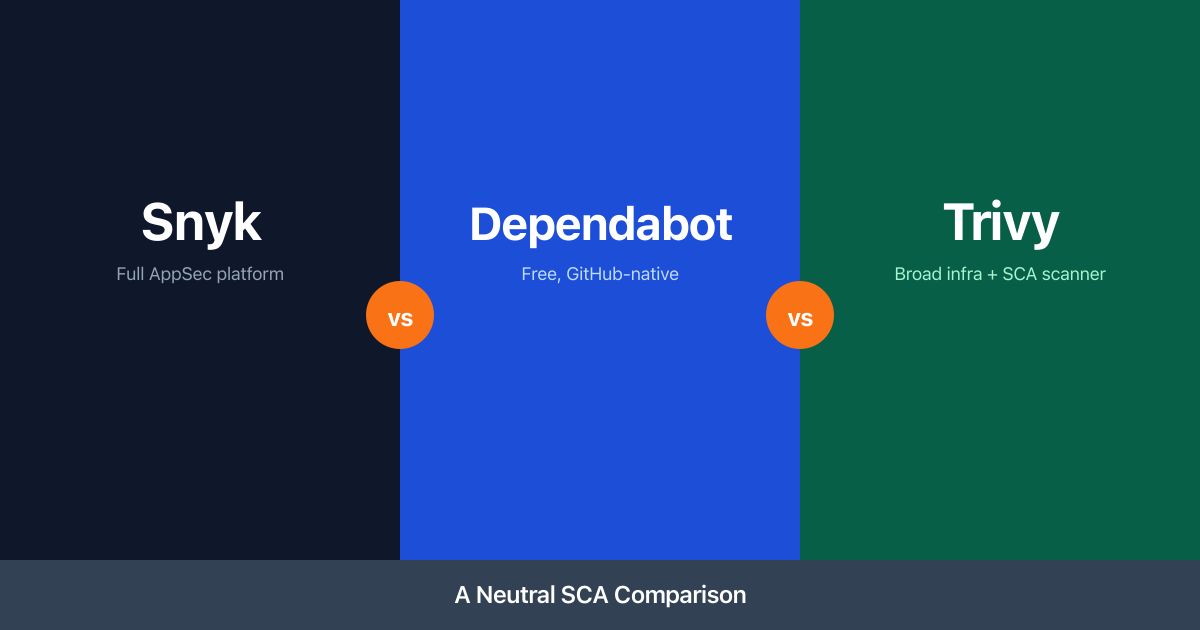
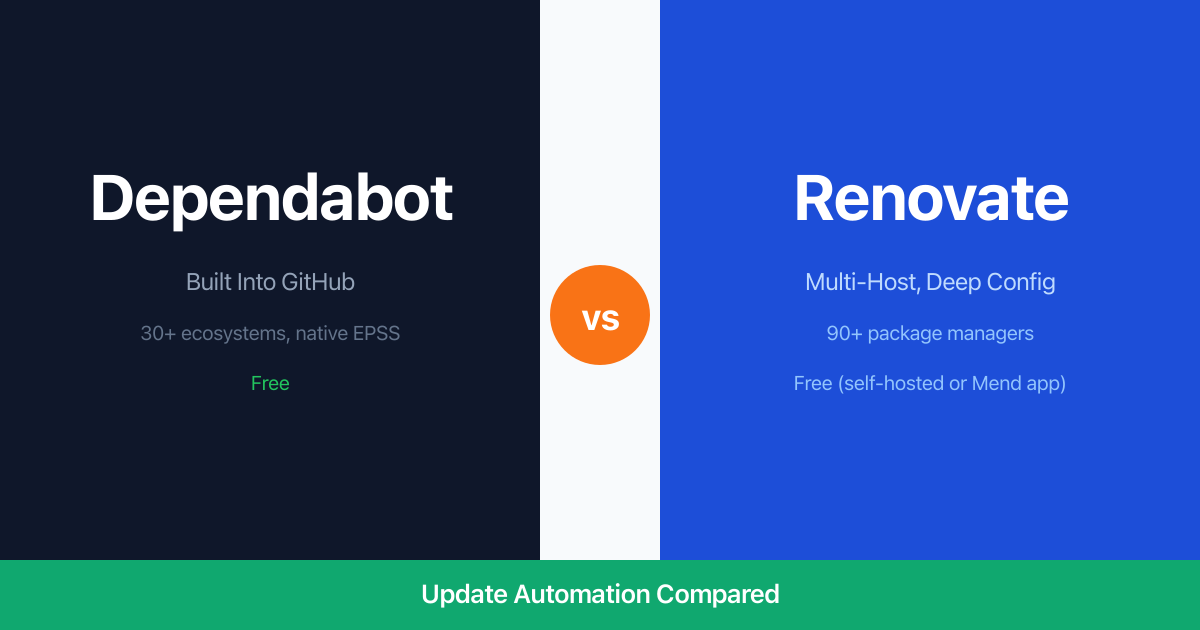
Dependabot is free, GitHub-native, and shows an EPSS score per alert, but has no CISA KEV signal, and hosted Dependabot only works on GitHub. Snyk adds an opt-in Risk Score weighing EPSS and reachability, plus a CISA KEV filter, but its free tier caps at 200 Open Source tests and Team costs $25 per developer (minimum 5). Choose Dependabot for free GitHub automation; choose Snyk for SAST or multi-host coverage.
Search "Snyk vs Dependabot" and the top results are almost all written by one of the two — a Snyk sales page arguing you need more than GitHub gives you for free, or a GitHub doc explaining why native tooling is enough. Neither side is lying, exactly, but neither is positioned to tell you which one actually fits your team.
We build a competing dependency scanner (GeekWala) — full disclosure up front. This comparison scores Snyk and Dependabot on the same checklist, puts the feature table before any opinion, and keeps GeekWala out of everywhere except one section at the end, where it's a genuinely relevant, checkable gap rather than a sales pitch.
In This Article
- Snyk vs Dependabot at a glance
- Detection and ecosystem coverage
- Alerts vs automated fixes
- Prioritization: Snyk Risk Score vs Dependabot's native EPSS
- Pricing
- Choose Dependabot if
- Choose Snyk if
- Where an EPSS + KEV layer fits
- Frequently asked questions
Snyk vs Dependabot at a Glance
| Dimension | Snyk | Dependabot |
|---|---|---|
| Primary scope | Full AppSec platform (SAST + SCA + container + IaC) | Dependency alerting + automated fix PRs |
| Advisory source | Proprietary Snyk DB (own research + NVD) | GitHub Advisory Database (GitHub-reviewed advisories; NVD is one upstream source) |
| Ecosystem coverage | 10+ | Alerts: the 12 Advisory Database ecosystems; version updates: 30+ package managers (incl. Docker, Terraform, GitHub Actions) |
| EPSS | A factor in the Early Access Risk Score; EPSS score and percentile as Reports columns (Enterprise plan) | Yes — per-alert score, sort, filter and auto-triage criterion (GA Feb 2025) |
| CISA KEV | Yes — KEV issue filter (April 2026, plans not stated), plus a Reports column (Enterprise plan) | No |
| Automated fix PRs | Yes | Yes |
| Deployment model | Hosted dashboard + CLI + IDE plugins | GitHub-native (Security tab + PRs) |
| Hosting requirement | GitHub, GitLab, Bitbucket, Azure Repos | GitHub (hosted); open-source dependabot-core can be self-hosted |
| CI/CD integration | GitHub Actions, Jenkins, CircleCI, plus CLI-based pipelines | Native to GitHub |
| Free tier | 200 Open Source tests, 5 projects | Free on GitHub repos, no test cap |
| Paid entry point | Team "starting at $25/month" for up to 10 developers on snyk.io/plans; Snyk's Team page prices it at $25 per contributing developer/month, minimum 5 | $0 |
| Wins on | Prioritization depth, reachability, IDE integration, compliance controls | Zero cost, zero setup, native to where the code already lives |
| Loses on | Pricing beyond the free tier, free-tier test caps | No CISA KEV signal, GitHub-centric, no SAST/container/IaC scanning |
Pricing and feature figures verified against each vendor's own published pages and documentation, October 2026.
Detection and Ecosystem Coverage
Dependabot's version updates support 30+ package managers, including some outside typical "SCA" scope — Docker base images, Terraform providers, and GitHub Actions versions, not just application package managers. Its vulnerability alerts, though, cover the 12 ecosystems in the GitHub Advisory Database. It reads directly off your manifest and lockfiles the moment you enable it; there's no separate scan step to configure.
Snyk Open Source covers 10+ ecosystems and layers its own proprietary vulnerability research on top of NVD, including vulnerabilities its security team discovers and discloses itself. Coverage is broader in kind — Snyk's suite also does SAST (Snyk Code), container scanning, and IaC scanning under one dashboard, none of which Dependabot scans for vulnerabilities.
If your one criterion is "does it catch vulnerable dependency versions in my primary language," both do the job. The divergence is in what else comes bundled and what it costs to get there.
Alerts vs Automated Fixes
Both tools open pull requests, not just alerts, which is worth stating plainly because a lot of dependency tooling stops at reporting.
- Dependabot raises a version-bump PR for each alert that has a patched version once Dependabot security updates are enabled, runs your existing CI against it, and lets you review and merge through the same flow you already use. No separate integration step.
- Snyk opens fix PRs too. For Node.js projects it can also apply a Snyk-maintained patch to selected high-impact vulnerabilities when no fixed version exists — something Dependabot doesn't do, since it can only propose a version the ecosystem's registry actually publishes.
Where they diverge in practice is hosting: hosted Dependabot's automated PRs only exist on GitHub. If any part of your org is on GitLab, Bitbucket, or Azure Repos, you either run the open-source dependabot-core yourself and wire up the PRs, or the automated-fix flow doesn't reach those repos — Snyk integrates with those hosts out of the box.
Prioritization: Snyk Risk Score vs Dependabot's Native EPSS
This is the dimension most likely to actually change your triage workflow, and it's more nuanced than either vendor's marketing suggests.
Dependabot shipped a native EPSS score and percentile on alerts in February 2025 — on alerts whose advisory has a CVE with EPSS data — you can sort and filter alerts by it, and use it as a custom auto-triage rule criterion ("only open a PR when EPSS is above X"; on private repositories, custom rules need GitHub Code Security). The default sort is "Most important", which weighs CVSS score, dependency scope, and whether vulnerable function calls are detected, rather than EPSS. What Dependabot doesn't have is any CISA KEV cross-reference — you can't ask "is this one confirmed under active exploitation."
Snyk's Risk Score (in Early Access for Snyk Open Source and Snyk Container, on all plans, enabled through your Snyk account team; otherwise Snyk shows its Priority Score) combines likelihood factors — including EPSS, exploit maturity, advisory age, and reachability (does your code actually call the vulnerable function?) — with impact into a single ranked number. Reachability is GA for Java, JavaScript/TypeScript, and Python in Snyk's source-control integrations (Early Access in the CLI and CI/CD), and it can push down a "critical" CVE your code never invokes. On the Enterprise plan, EPSS scores and percentiles are also available as columns in Snyk Reports. And since April 2026, Snyk has a Known Exploited Vulnerabilities filter that isolates issues listed in CISA's KEV catalog.
Net: Dependabot gives you EPSS for free on GitHub; Snyk folds EPSS and reachability into one score and adds a CISA KEV filter, inside a paid-beyond-the-free-tier platform. Only Snyk gives you CISA KEV.
Pricing
Dependabot is free at any team size, on any public or private GitHub repo, with no account beyond GitHub itself and no test-volume cap.
Snyk's free plan includes 200 Open Source tests, 100 Code tests, 300 IaC tests, and 100 Container tests, across 5 projects (verified October 2026) — a ceiling a normal CI pipeline running snyk test on every commit can burn through inside a sprint. The Team plan is aimed at teams of up to 10 developers. As of October 2026 Snyk's plans page lists it as "starting at $25/month" without a per-developer rate, while its Team page prices it at $25 per contributing developer per month with a 5-developer minimum, so expect about $125/month for the smallest team. Above that, Enterprise is a custom, credit-based subscription. Where Snyk counts seats, a "contributing developer" is anyone who has committed to a monitored private repo in the last 90 days.
Choose Dependabot If
- Your entire stack lives on GitHub
- You want automated fix PRs at zero cost with no signup beyond GitHub
- CVSS-plus-EPSS is enough signal for your triage process, and you don't need CISA KEV
- You don't need SAST, container, or IaC scanning bundled in
Choose Snyk If
- You need SAST, container, and IaC scanning under one dashboard alongside dependency scanning
- Reachability analysis and a CISA KEV filter would materially change your triage volume
- You're on GitLab, Bitbucket, Azure Repos, or a mix of hosts, not just GitHub
- License compliance, SSO/SAML, and audit logging are hard requirements
- Budget supports a paid plan once you outgrow the free tier's test caps
Where an EPSS + KEV Layer Fits
Dependabot's EPSS column is a genuine capability, not a gap. EPSS itself is maintained by FIRST, the organization that also hosts the CVSS SIG, and scores the probability a given CVE will be exploited in the next 30 days — a different question than CVSS's "how bad would it be." The gap, checkable against Dependabot's current interface as of this writing, is CISA KEV: Dependabot doesn't tell you whether a vulnerability is confirmed under active exploitation. CISA's KEV catalog is a much smaller, much higher-confidence list than "everything with a CVE" — a flag most teams would triage on immediately if it were visible. Snyk added a KEV filter in April 2026, so on Snyk the signal exists — check that the issue filters are available on the plan you're on.
GeekWala publishes this comparison and sells a dependency scanner that shows CISA KEV and EPSS as separate fields on every finding across 8 ecosystems, including on its free tier. It's most useful layered on top of Dependabot — adding the KEV signal Dependabot lacks without moving off GitHub — and it doesn't replace Snyk's SAST, container, or reachability analysis. We're naming this because it's a specific, verifiable gap in Dependabot today, not because this article is trying to relitigate the comparison above in our favor.
For the full technical breakdown of Dependabot's EPSS auto-triage rules specifically, see 200 Dependabot Alerts: Which 3 to Fix Today. For the three-way version of this comparison including Trivy, see Snyk vs Dependabot vs Trivy. For full feature-and-pricing matrices, see GeekWala vs Snyk and GeekWala vs Dependabot.
Frequently Asked Questions
Is this comparison funded or influenced by Snyk or GitHub?
No. We build a competing dependency scanner and disclosed that above. The feature table and pricing figures are checkable against each vendor's own current pages, independent of our own product's feature set.
Can I use both Snyk and Dependabot together?
Yes, and some teams do — Dependabot for free, zero-setup automated PRs on GitHub repos, Snyk for SAST/container/IaC scanning or reachability analysis where the free tier's limits aren't a constraint. They overlap on dependency alerting specifically but Snyk covers meaningfully more scan types.
Does Dependabot really have EPSS now, or is that outdated information?
It's current. GitHub GA'd native EPSS scores and percentiles on Dependabot alerts in February 2025, and you can still sort, filter, and write auto-triage rules on it today. What Dependabot still lacks is a CISA KEV field, and EPSS isn't the default sort — alerts default to "Most important", which weighs CVSS score, dependency scope, and whether vulnerable function calls are detected.
Which is better for a solo developer or small open-source project?
Dependabot, in almost every case — it's free at any scale, requires no signup beyond GitHub, and handles the automated PR step end to end. Snyk's free tier is usable at small volume but its test caps bite faster than most solo workflows expect.
Why doesn't this article declare an overall winner?
Because Snyk and Dependabot aren't actually competing for the same job. Dependabot is a free, GitHub-native alerting-and-patching layer; Snyk is a paid, multi-host AppSec platform where dependency scanning is one product among several. The honest answer depends on whether you need the rest of Snyk's platform, not on which tool scans dependencies "better."
Two tools solving different-sized problems — pick based on scope, not just cost.
See how GeekWala's EPSS + CISA KEV enrichment layers on top of tools like these → — upload any lock file across 8 ecosystems and see exploitation probability and KEV status for every CVE-linked finding. No account needed for the first 10 packages (3 scans per day); a free account with a verified email lifts the cap.